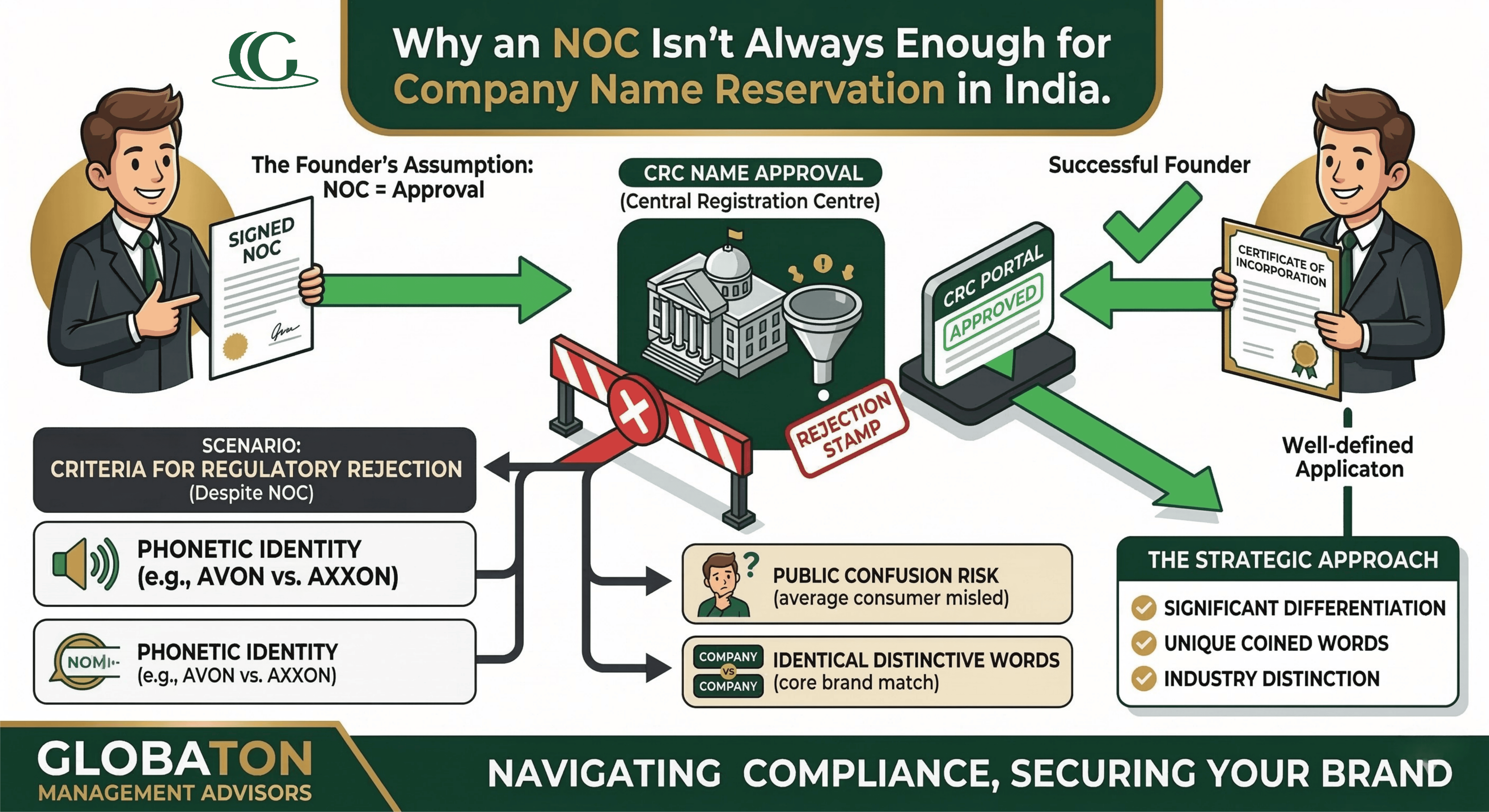
Many founders believe that obtaining a No Objection Certificate (NOC) from an existing company is a golden ticket to securing a similar business name. However, the reality at the Central Registration Centre (CRC) is often quite different. At Globaton, we frequently consult with entrepreneurs who are surprised to find their applications rejected despite having a signed agreement in hand.
The truth is that an NOC is just one piece of the puzzle, and in many cases, it is not enough to override the fundamental rules of name reservation.
The Logic Behind the Rejection
The Ministry of Corporate Affairs (MCA) has a primary responsibility to protect the general public. Their goal is to ensure that a customer or vendor can clearly distinguish between two different businesses.
If your proposed name is phonetically or visually identical to an existing brand, the CRC may decide that the risk of public confusion is too high. Even if the existing company is your sister concern or a friendly partner that has given you written permission, the regulator looks at the situation through the eyes of an average consumer. If the consumer cannot tell you apart, the name will likely be rejected.
 When an NOC Fails?
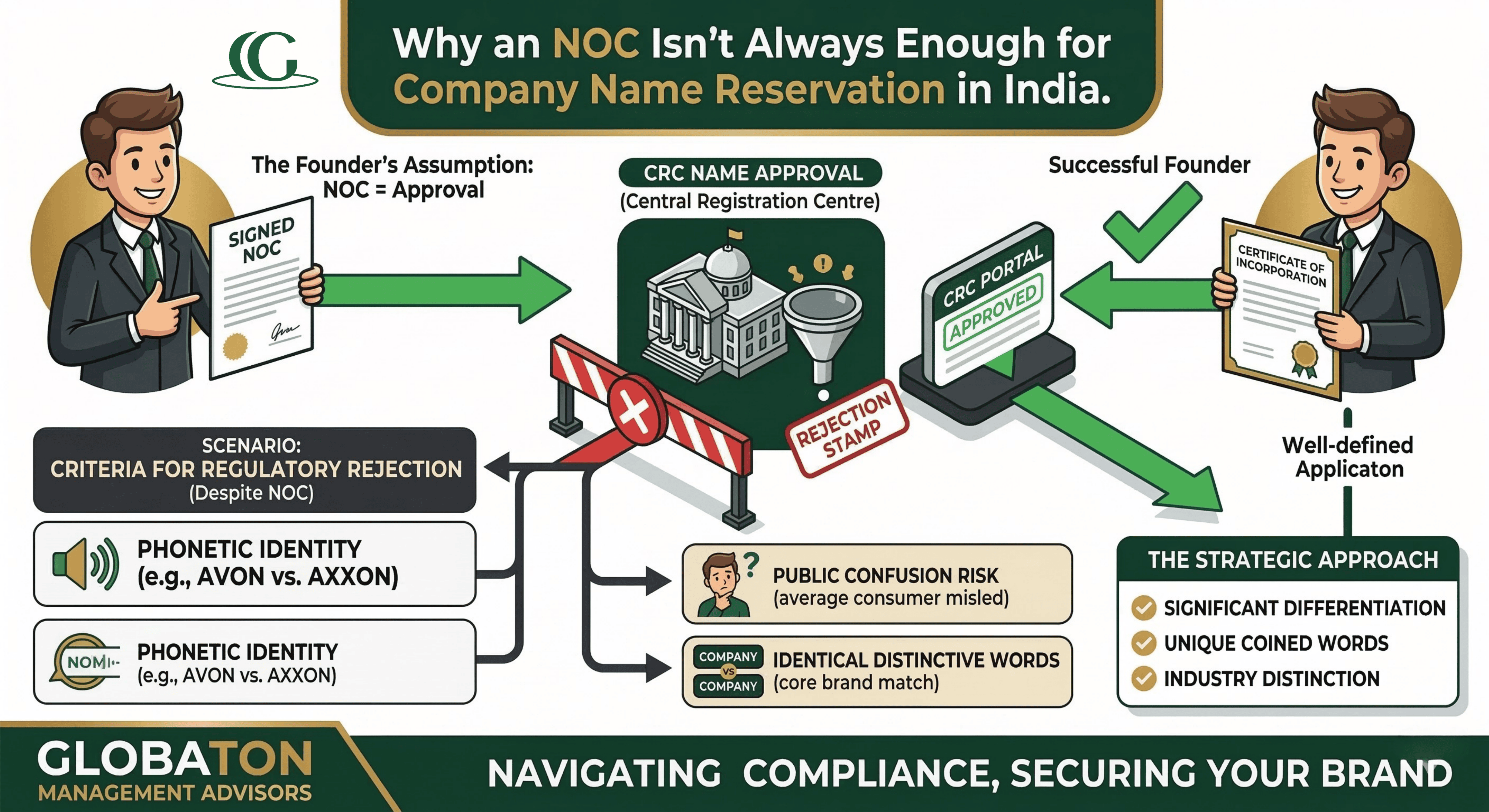
There are specific scenarios where the CRC typically looks past an NOC:
Phonetic Identity: If your name sounds exactly like another, the NOC often carries little weight. The regulator assumes the public will hear the name and assume it is the same entity.
Identical Distinctive Words: If the core, unique part of the name is the same as a well known brand, adding a different suffix or obtaining an NOC may not be sufficient.
Public Interest: If the name is so similar that it could be used for fraudulent activities or misrepresentation, the authorities will prioritize public safety over a private agreement between two parties.
How to Strengthen Your Position?
While an NOC is not a guarantee, it is still a vital document when dealing with group companies or related parties. To improve your chances:
Differentiate the Industry: Ensure your business activity is significantly different from the entity providing the NOC.
Explain the Relationship: Clearly state the relationship between the two companies in your filing. If they are part of the same group, mention this explicitly.
Focus on Branding: Use the NOC as a secondary support tool while focusing primary efforts on creating a name that has at least one distinct, non-generic word.
Navigating these nuances requires a strategic approach to compliance. At Globaton, we help you look beyond the paperwork to understand how the regulators think, ensuring your journey from idea to incorporation is as smooth as possible.
Frequently Asked Questions
Can the CRC reject my name even if I have an NOC from the existing company?
Yes. The CRC has the discretionary power to reject a name if it "too nearly resembles" an existing one. Their priority is preventing public confusion, which an NOC does not always resolve.
In what cases is an NOC actually helpful?
An NOC is most effective when the companies are part of the same group or when the names are slightly similar but the business activities are entirely different. It acts as a supporting document but not a final clearance.
Does an NOC help with Trademark issues?
An NOC for a company name is different from a trademark consent letter. While it may help with the MCA, you still need to ensure you are not infringing on someone else's intellectual property rights under the Trademarks Act.
What should I do if my name is rejected despite having an NOC?
You should analyze the rejection remarks provided by the CRC. Often, the best path forward is to modify the proposed name to make it more distinctive rather than trying to force the original name with the same NOC.
Is there a specific format for an NOC?
Yes, it should ideally be on the letterhead of the existing company, signed by an authorized director, and backed by a board resolution authorizing the use of the name by the new entity.