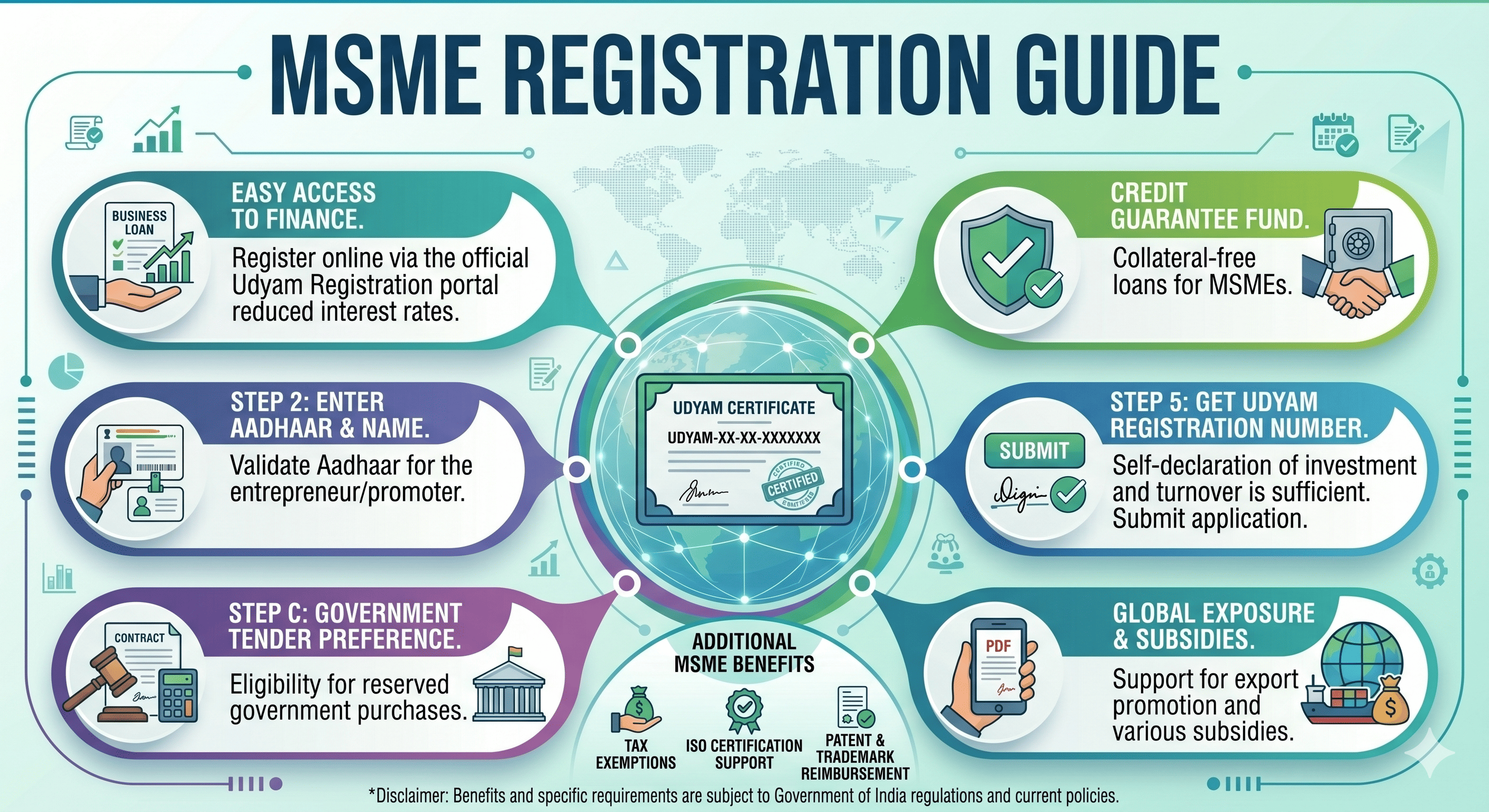
If you are building a startup or running a small business in India, every single rupee, contract, and day of cash flow counts. When you are operating in survival mode, looking for every advantage is not just smart: it is necessary.
One of the most powerful, government-backed tools available to Indian entrepreneurs is MSME Registration, officially known as Udyam Registration.
Many founders assume that MSME registration is only meant for traditional manufacturing units or local brick-and-mortar shops. This is a massive misconception. Modern tech startups, service providers, and consulting firms can all qualify as MSMEs. This simple digital certificate is a passport to a world of financial safety nets, cheaper loans, and legal protection.
Let us walk through the incredible benefits that MSME registration brings to your business and clarify exactly how the "renewal" process works so you can keep your benefits active without a single day of downtime.
The Big Wins: Why Your Startup Needs MSME Registration
The Indian government is deeply committed to supporting small businesses. When you register on the Udyam portal, you officially signal that you are part of this critical economic sector, unlocking several valuable protections and perks.
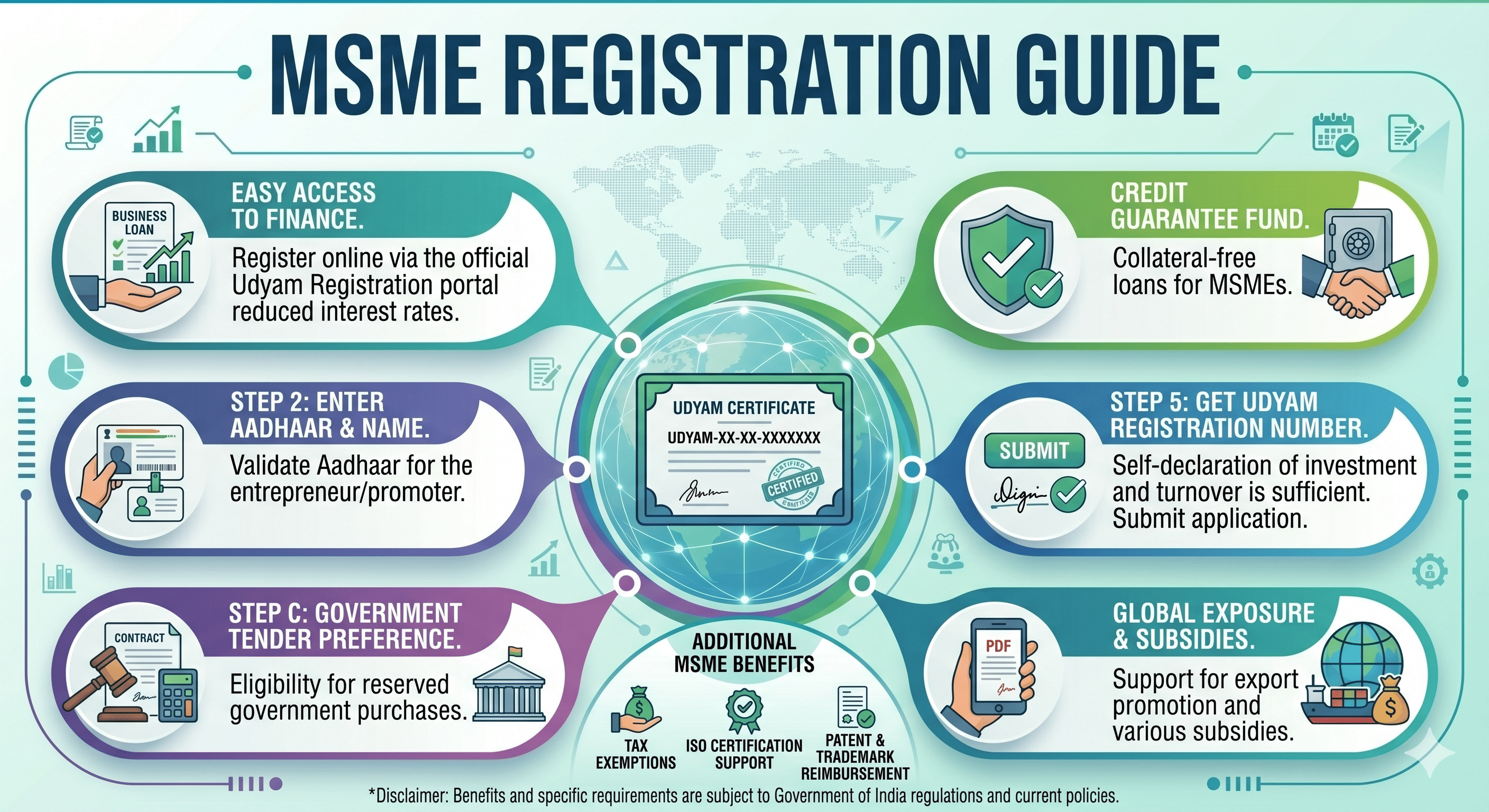
1. The 45-Day Delayed Payment Protection
Cash flow is the lifeblood of any startup, and nothing hurts a young business like waiting months for clients to pay their bills. Under Section 15 of the MSMED Act, registered MSMEs are protected by a strict legal payment window.
When you supply goods or services to a buyer, they are legally obligated to pay you within 45 days of accepting your work (or within 15 days if there is no written agreement). If they delay past this limit, they must pay you compound interest that is three times the bank rate. Having this legal leverage in your invoices completely changes the dynamic when dealing with larger corporate clients.
2. Collateral-Free Bank Loans
Securing capital without risking your personal assets is one of the hardest parts of scaling a startup. MSME-registered businesses get priority access to credit guarantee schemes like the Credit Guarantee Fund Trust for Micro and Small Enterprises (CGTMSE).
Through these programs, banks and financial institutions can offer you collateral-free business loans. The government acts as your guarantor, reducing the bank's risk and lowering your interest rates by up to 3 to 5 percent annually compared to standard commercial loans.
3. Up to 50 Percent Subsidy on Patents and Trademarks
Protecting your intellectual property is vital, but the registration fees for trademarks, copyrights, and patents can quickly add up. To encourage innovation, the government offers registered MSMEs a massive 50 percent subsidy on intellectual property filing fees, helping you safeguard your brand identity and proprietary tech at a fraction of the cost.
4. Government Tender Preferences
Landing a government contract can secure your startup's financial runway for years. However, entering these bids usually requires a hefty deposit known as Earnest Money Deposit (EMD). Registered MSMEs are completely exempt from paying this deposit, which allows you to pitch for high-value tenders without locking up your precious working capital.
The "Renewal" Myth: Do You Need to Renew Your Certificate?
One of the most common questions our team of business consultants receives is, "How often do I need to renew my MSME certificate?"
Here is the good news: Udyam Registration is valid for a lifetime.
Once your business is successfully registered on the Udyam portal, your certificate does not expire, and you do not need to file a formal "renewal" application every year. However, there is a very important catch that many founders miss.
The Annual Update Requirement
While the certificate itself is permanent, your business details are not static. Your revenue will grow, your team will expand, and your investments in machinery or technology will change.
Because of this, you are required to keep your business information updated on the Udyam portal. The system is integrated with the Income Tax and GST portals, meaning it will automatically pull data from your filed Income Tax Returns (ITR) and GST returns to assess your business size.
However, you must manually log in and update any administrative changes, such as:
● Changes to your registered business address or branch offices.
● Updates to your business bank account details.
● Modifications to your core business activities (adding or changing NIC codes).
● Changes in the ownership structure or contact details.
Failing to maintain accurate tax records or neglecting to update the portal when your business undergoes structural shifts can lead to misclassification. In worse-case scenarios, it can result in your business losing access to micro-specific subsidies or facing challenges during bank audit checks.
Why Navigating MSME Setup with Business Advisors is Smarter
While the Udyam portal is designed to be user-friendly, setting it up correctly requires a strategic eye. The classifications you choose and the activities you declare will dictate which government schemes, subsidies, and legal protections you can actually access.
This is where professional business advisors and corporate advisory experts make all the difference.
What a Dedicated Consultant Does for You:
● Flawless Initial Setup: Experienced business consultants ensure that your enterprise is classified under the correct NIC codes, ensuring you do not accidentally disqualify yourself from key sector-specific benefits.
● Seamless Annual Integration: Small business advisors ensure your GST, ITR, and Udyam portal data match perfectly, preventing any administrative discrepancies that could halt your bank loan approvals.
● Proactive Advisory on Schemes: Beyond the certificate, a professional advisory team helps you actively apply for relevant subsidies, interest subvention schemes, and government grants that align with your industry.
Build a Resilient, Protected Business with Globaton
MSME registration is more than just a certificate on your office wall; it is a shield that protects your cash flows and a key that opens doors to affordable capital. By securing your Udyam status and keeping your records continuously updated, you build a firm financial foundation for your startup.
At Globaton, we act as your strategic growth partners. Our team of skilled company registration consultants and business advisors handle your entire MSME journey, from initial documentation and portal registration to annual compliance updates and subsidy applications.
Let us handle the administrative details so you can focus entirely on scaling your vision. Reach out to Globaton today to learn how we can help your business unlock the full power of MSME benefits.
Frequently Asked Questions
Does our MSME (Udyam) Registration certificate expire, and do we need to renew it?
No, your Udyam Registration certificate does not have an expiration date. It is legally valid for a lifetime. However, you must keep your business profile updated. The Udyam portal is directly linked with the Income Tax and GST networks, meaning it automatically updates your investment and turnover numbers every year based on your tax filings. If you change your registered office address, add new branch offices, open a new bank account, or shift your core business activities (such as adding new National Industrial Classification codes), you must manually log in and update these details on the portal to prevent any legal discrepancies. Our small business advisors can handle these annual administrative updates on your behalf to keep your profile flawless.
What are the exact investment and turnover limits for MSME classification?
The Ministry of Micro, Small and Medium Enterprises classifies businesses based on a composite formula of investment in plant and machinery (or equipment) and annual turnover: - Micro Enterprise: Investment must not exceed 1 crore rupees, and annual turnover must not exceed 5 crore rupees. - Small Enterprise: Investment must not exceed 10 crore rupees, and annual turnover must not exceed 50 crore rupees. - Medium Enterprise: Investment must not exceed 50 crore rupees, and annual turnover must not exceed 250 crore rupees. If your startup grows and exceeds these limits, the Udyam portal will automatically transition your business to the next higher category during the next financial year.
How does the MSMED Act protect my startup from delayed payments?
One of the most valuable MSME registration benefits is the strict protection under Section 15 of the MSMED Act: The Payment Window: When you supply goods or services to a buyer, they are legally required to pay you within a maximum period of 45 days from the date of acceptance (or within 15 days if there is no written contract). The Interest Penalty: If the buyer fails to pay within this timeframe, they are legally liable to pay you compound interest on the outstanding amount. This interest is calculated at 3 times the benchmark bank rate declared by the Reserve Bank of India. Balance Sheet Disclosure: Large corporate buyers must officially declare any delayed payments to MSME vendors on their public financial statements, which gives you exceptional leverage when chasing up invoices.
Can our software startup or digital marketing agency register as an MSME?
Yes, absolutely. The old distinction between manufacturing and service industries was eliminated under the updated Udyam guidelines. Modern tech startups, software firms, digital agencies, consulting companies, and logistics providers are fully eligible for MSME registration benefits. As long as your investment and turnover fall within the official brackets, you can register and claim interest rate concessions, IP subsidies, and collateral-free loan benefits. Our business consultants can assist you in selecting the correct National Industrial Classification (NIC) codes during registration to ensure a smooth application.
What documents do we need to provide for Udyam Registration?
The registration process is fully paperless and digital. To initiate the filing, our corporate advisory team in India will require: -The Aadhaar number of the promoter or authorized director. -The permanent PAN card details of the business entity. -The Goods and Services Tax Identification Number (GSTIN) of your company. -Your official bank account number and IFSC code.