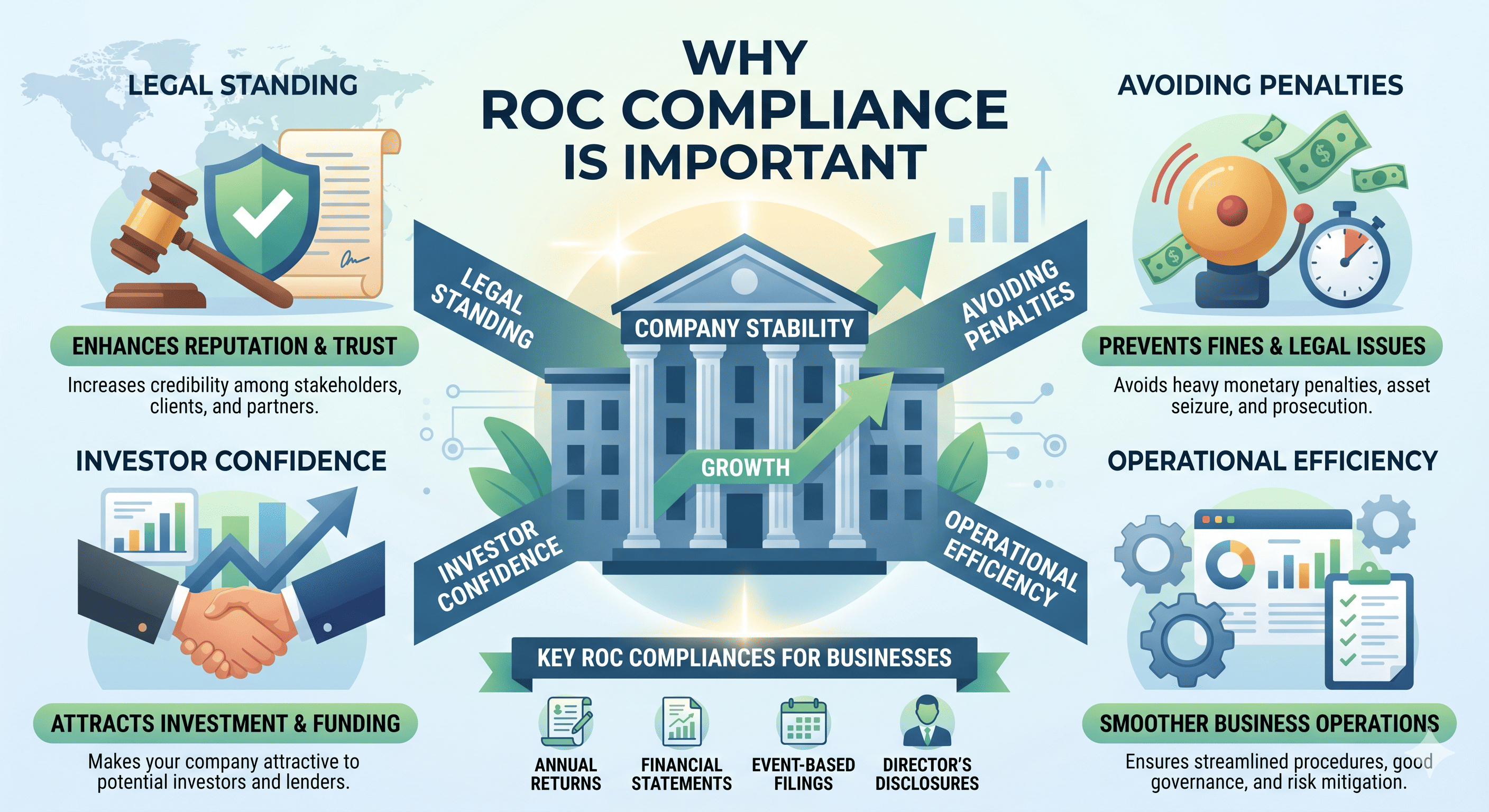
Starting a new business is an exhilarating ride. You have a disruptive idea, a passionate team, and a vision to change the market. In the midst of refining your product, chasing customers, and building a brand, it is incredibly easy to overlook the quiet, administrative side of running a company.
For registered start-ups in India, one of the most critical administrative areas is ROC compliance.
The Registrar of Companies, commonly known as the ROC, is the regulatory body that oversees every registered company under the Ministry of Corporate Affairs. While compliance might feel like a tedious checklist of paperwork, it is actually the foundation upon which your start-up's credibility, funding potential, and long-term survival are built.
Let us dive into why keeping up with ROC compliances is essential for your start-up, and how partnering with the right business advisors can make the journey seamless.
What Exactly is ROC Compliance?
When you register your start-up as a Private Limited Company or a Limited Liability Partnership, you enter into a legal contract with the government. In exchange for benefits like limited liability and separate legal existence, your company agrees to maintain transparency.
ROC compliance is simply the process of reporting your company’s financial health, management changes, and operational updates to the government every year. This includes filing annual returns, submitting audited financial statements, keeping track of board meetings, and reporting any major structural changes in your business.
Key ROC Forms Every Start-up Founder Must Know
Navigating the Ministry of Corporate Affairs portal can sometimes feel like trying to learn a completely new language. To help you stay on track, here are the primary annual and one-time compliance forms you need to keep on your radar:
1. Form INC-20A: Commencement of Business
If you have recently incorporated your company, this is your very first milestone. You must file Form INC-20A within 180 days of incorporation to declare that your shareholders have deposited their initial subscription money. Without this filed declaration, your start-up cannot officially begin business operations or exercise any borrowing powers.
2. Form AOC-4: Financial Statements
This is where you report your overall financial health to the government. Every year, you must submit your company's audited balance sheet, profit and loss statement, directors' report, and auditor's report through Form AOC-4. It must be filed within 30 days of holding your Annual General Meeting (AGM). Even if your start-up had zero transactions during the year, filing a "nil" AOC-4 is still mandatory to stay active.
3. Form MGT-7 or MGT-7A: The Annual Return
While AOC-4 is about your financials, Form MGT-7 is about your company's management structure and shareholding. It details who your directors are, who holds shares, any transfers of shares that occurred during the fiscal year, and the details of board meetings held. Small start-ups and One Person Companies (OPCs) can file a simplified, shorter version called Form MGT-7A. This form must be filed within 60 days of your AGM.
4. Form ADT-1: Appointment of Auditor
Every start-up must appoint a statutory auditor at its first AGM to audit its accounts. Form ADT-1 is used to notify the ROC of this appointment or reappointment, which is typically done for a block of five years. This form must be filed within 15 days of the AGM where the auditor was appointed.
5. Form DIR-3 KYC: Director Verification
This is an annual verification requirement for every individual who holds a Director Identification Number (DIN). Even if a director is not currently active, or if your start-up is going through a quiet phase, directors must submit their KYC verification by September 30th every single year to keep their DIN active and valid.
The True Cost of Ignoring Compliances
Many founders believe they can push compliance to the backseat until they scale. This is a risky misconception. The consequences of neglecting ROC guidelines can be severe, often hitting start-ups when they are most vulnerable.
1. Heavy Financial Penalties
The government has become increasingly strict about timely filings. Missing deadlines does not just result in a polite reminder. It triggers daily compounding penalties that can quickly drain a startup’’s fragile cash reserves.
2. The Dreaded "Defaulter" Status
If a company fails to file its returns for two consecutive years, the ROC has the power to strike off the company's name from the register. Even worse, the directors of the company can be disqualified from starting or managing any other company for up to five years.
3. Investor Red Flags
Are you planning to raise funds soon? Investors conduct thorough legal and financial due diligence before writing a check. If your ROC filings are messy or incomplete, it signals poor corporate governance. No venture capitalist wants to inherit a legal headache, meaning delayed compliances can cost you your funding.
Why Compliance is Actually a Growth Tool?
Instead of viewing ROC compliances as a legal burden, successful founders view them as a strategic asset.
● Builds Unshakable Credibility: A company with an active, compliant status on the Ministry of Corporate Affairs portal instantly wins the trust of banks, vendors, and large corporate clients.
● Smooth Valuation and Funding: Clear records make the due diligence process incredibly fast, allowing you to close funding rounds without administrative delays.
● Protects Your Limited Liability: Staying compliant ensures that the legal wall protecting your personal assets from business liabilities remains firmly in place.
Why Start-ups Need Expert Business Consultants?
Let us be honest, you did not start a business to spend your weekends reading the Companies Act. Deciphering legal terminologies, tracking filing dates, and preparing board resolutions requires specialized knowledge.
This is where professional business consultants and advisors step in.
Partnering with a reliable corporate advisory firm like Globaton allows you to delegate the legal complexities to experts. Here is how professional business advisors add value to your start-up:
● Proactive Deadline Tracking: Expert consultants ensure you never miss a filing date, saving you thousands of rupees in avoidable penalties.
● Strategic Advisory: Beyond paperwork, business advisors help you structure your board, manage equity dilution, and plan for future compliance needs as you scale.
● Peace of Mind: With compliance handled by professionals, you can redirect 100 percent of your energy toward what you do best, which is growing your business.
Final Thoughts: Secure Your Start-up’s Future Today
Compliance is not a chore to be done at the end of the year; it is an ongoing practice of good corporate hygiene. By staying on top of your ROC compliances, you build a resilient, investor-friendly business that is ready to scale heights.
If you are looking for trusted company registration consultants or experienced business advisors to navigate the compliance landscape, we are here to help. Reach out to Globaton today, and let us build a strong, compliant foundation for your dream start-up.
Frequently Asked Questions
What happens if my startup misses the deadline for annual ROC filings?
Missing your Registrar of Companies filings does not simply result in a gentle reminder. The Ministry of Corporate Affairs imposes immediate, daily compounding penalties. For major forms like AOC-4 and MGT-7, the standard penalty is 100 rupees per day, per form, with no upper limit.
Is filing Form INC-20A mandatory even if our business is not active yet?
Yes, filing Form INC-20A (Commencement of Business declaration) is absolutely mandatory for every single newly incorporated company in India. You must file this form within 180 days of incorporation. This form proves that your shareholders have successfully paid their initial share subscription money into the company bank account. If you fail to file this declaration, your startup cannot officially begin operations, borrow capital, or open bank facilities. The ROC can also shut down your company if this form is not submitted on time.
Do we need to do annual filings if our startup has zero transactions or revenues?
This is a very common misconception. Even if your startup had zero transactions, zero revenue, and zero operational activity during the financial year, you are still legally required to maintain compliance. You must hold an AGM, get a statutory audit done, and submit "nil" filings for Form AOC-4 and MGT-7 or MGT-7A. Failing to do so will still trigger daily late fees and risk your corporate active status.