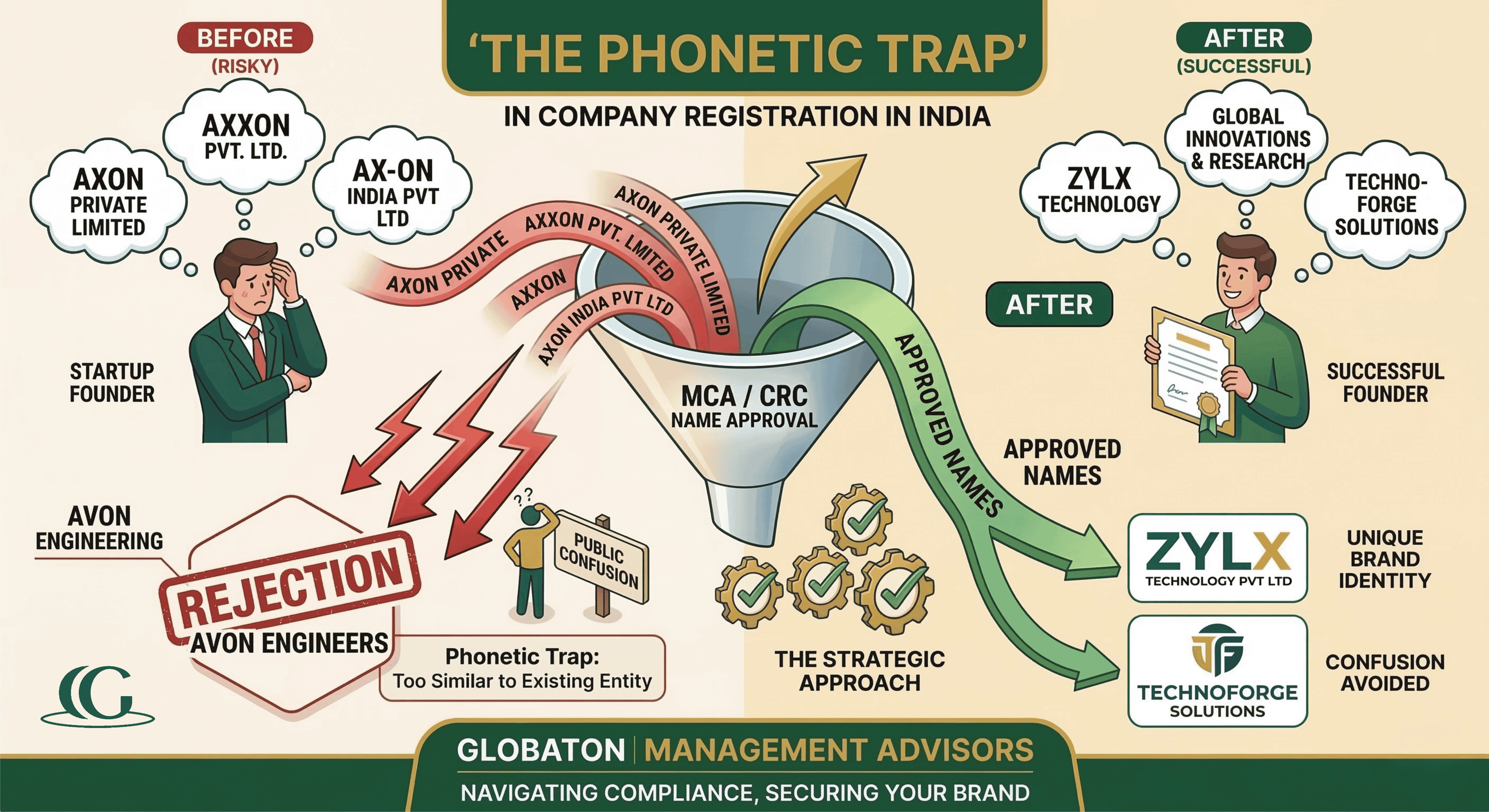
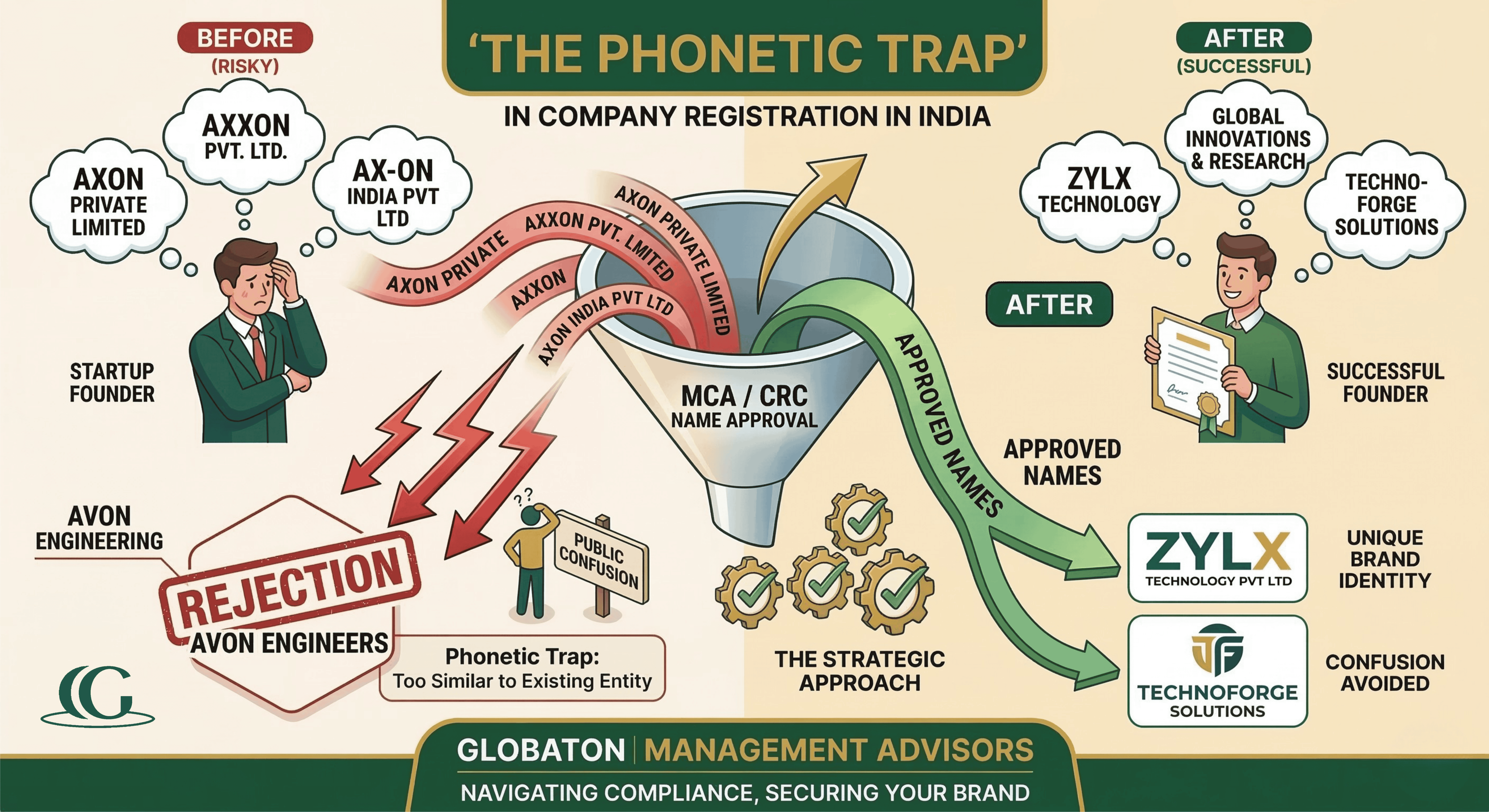
The "Phonetic Trap" in Company Registration
Choosing a name for your new startup feels like naming a child. You want it to be unique, meaningful, and capable of standing the test of time. However, in the world of Indian corporate law, there is a technical hurdle that catches even the most creative founders off guard: the phonetic resemblance rule.
At Globaton, we often see entrepreneurs arrive with a "perfect" name, only to have it rejected by the Central Registration Centre (CRC). Usually, the culprit is what we call the Phonetic Trap.
What is the Phonetic Trap?
The Ministry of Corporate Affairs (MCA) does not just look at how a name is spelled. It looks at how it sounds. If your proposed name sounds too much like an existing company or a registered trademark, the system will flag it as "too nearly resembling" an existing entity.
Think of it this way: the law aims to protect the public from confusion. If a customer hears your company name and could reasonably mistake it for another, the MCA will step in to prevent that overlap.
Real-World Examples of Rejections:
To give you an idea of how strict these checks are, consider these common scenarios that lead to rejections:
The Spelling Variation: If "Axxon Pvt Ltd" already exists, proposing "Axon Pvt Ltd" will almost certainly fail. Even though the letters are different, the sound is identical.
The Plural Pitfall: "Smart Solution" is considered the same as "Smart Solutions." Adding an 's' at the end does not qualify as a unique distinction.
The "And" vs. "&" Switch: Changing "Black and White" to "Black & White" or "Black-White" is seen as a cosmetic change, not a new identity.
The Translation/Transliteration: If "Rashtriya Vidyut Nigam Ltd" is already on the register, you cannot register "National Electricity Corporation Ltd." The meaning is the same, and so is the identity in the eyes of the law.
Why Small Differences Don’t Save You?
Many founders try to bypass the rule by adding a prefix like "New" or a suffix like "India." While this used to work years ago, the updated MCA V3 system uses more sophisticated algorithms. It identifies the "distinctive word" in your name. If that core word is already taken in a similar industry, your application will face a high risk of rejection.
 How to Navigate the Naming Process?
Before you print those business cards or buy that domain, take these steps:
Search Beyond the Exact Match: When using the MCA name search tool, don’t just type your full name. Search for variations and parts of the name to see what else sounds similar.
The Trademark Cross-Check: A name might be available on the MCA portal but already registered as a trademark. You need to check both databases to be safe.
Prioritize "Coined" Words: Some of the most successful brands (like Zomato or Infosys) use invented words. These are much easier to register because they have no phonetic history.
Justify the Significance: In your SPICe+ Part A filing, clearly explain what the name means and why it relates to your business. A strong justification can sometimes help in borderline cases.
Incorporating a company should be a moment of celebration, not a cycle of rejections and wasted fees. If you are feeling stuck in the naming phase or want to ensure your incorporation is handled with precision, we are here to help.
Frequently Asked Questions
Why was my company name application rejected when the spelling is completely different from the existing company?
The Central Registration Centre (CRC) does not just look at spelling; they look at phonetic resemblance. If two names sound identical or nearly identical when spoken, the application will be rejected to prevent public confusion. For example, registering "Axon Private Limited" when "Axxon Pvt. Ltd." already exists would be considered a phonetic similarity.
If the existing company gives me a No Objection Certificate (NOC), can I use a similar name?
While an NOC is sometimes required for other compliance matters, the CRC has the authority to disregard an NOC if the proposed name is deemed too nearly resembling an existing name. The goal of the regulation is to protect the general public from confusion, not just the existing entity.
What is the safest type of name to register to avoid the phonetic trap?
The most secure names are "coined words" unique invented words that have no phonetic history (e.g., "Zylx"). When selecting a name, it is best to avoid generic terms or minor variations (like adding an 's', or a prefix like 'New' or 'India') to a well-known brand, as the MCA V3 system will likely flag the distinctive root word.
What is a "restricted" or "forbidden" word in company names?
Certain words are restricted because they imply government patronage or require specific regulatory approvals. These include words like "Bank," "Insurance," "Stock Exchange," "Nidhi Limited," or any phrase suggesting connection to a government body. Using these without the necessary approval letter will lead to automatic rejection.
My name was rejected because I used a foreign city name. How can I get this approved?
If your proposed name includes the name of a foreign country or city (e.g., "London Consultants"), you must provide proof of connection, such as a Memorandum of Understanding (MOU) or evidence of collaboration/association with an entity from that country or city.