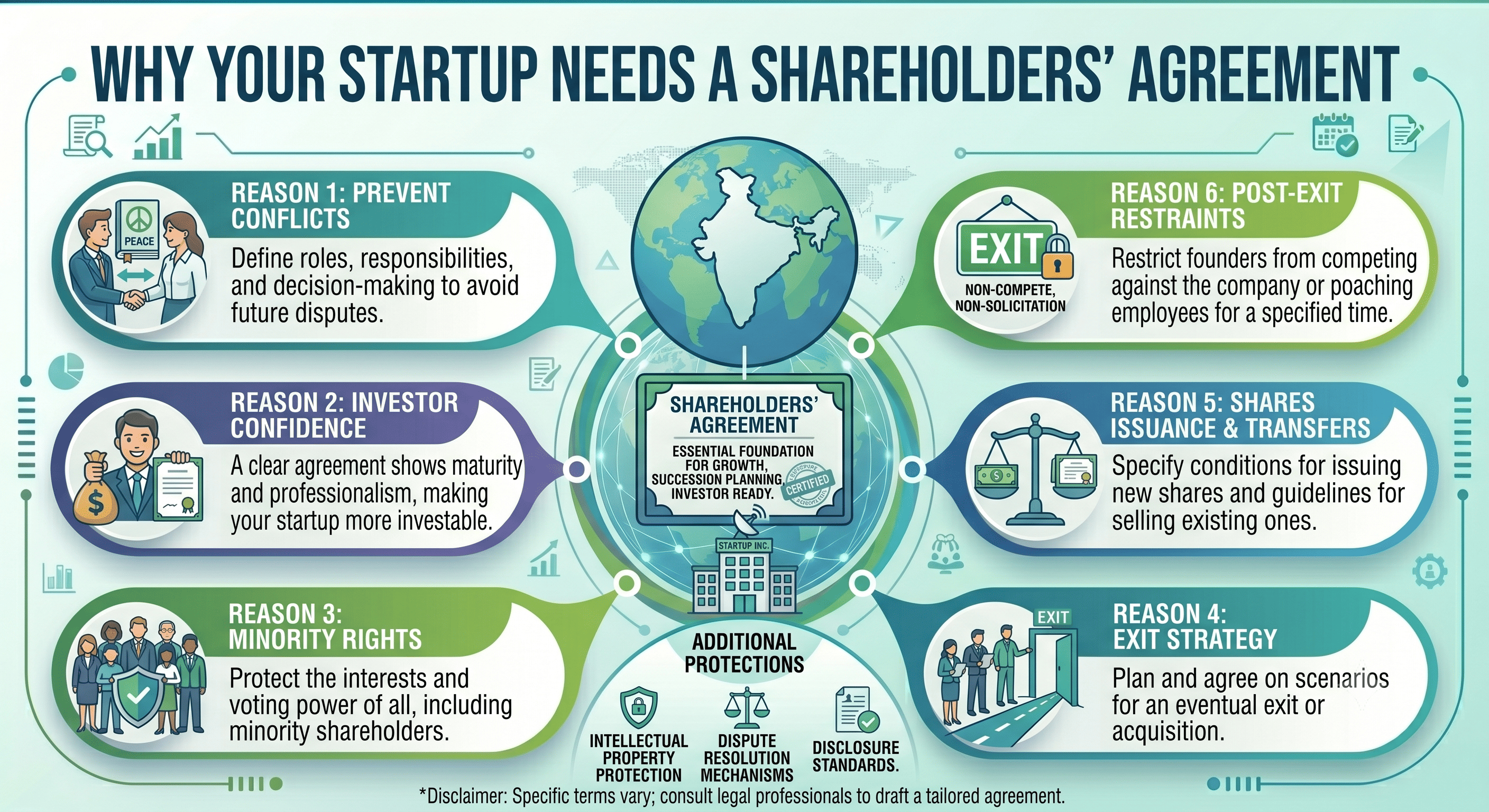
Think back to the early days of your startup. You and your co-founders were probably sitting in a coffee shop, scribbling ideas on a paper napkin, fueled by caffeine and pure excitement. In those early stages, everyone is perfectly aligned, the energy is electric, and the future looks incredibly bright.
But as any experienced entrepreneur will tell you, business, like life, is full of unpredictable turns.
What happens if one co-founder suddenly decides to leave the company after six months to pursue a different career? What if an investor wants to buy out your company, but one shareholder refuses to sell their small stake, blocking the entire deal?
This is exactly why a Shareholders Agreement, commonly known as an SHA, is the most critical document your startup will ever sign.
Rather than viewing it as a dry, pessimistic legal contract, successful founders view the SHA as a business safety net. It is a proactive, friendly roadmap that defines exactly how your business relationships will work, protecting your hard work and preserving your friendships when tough decisions need to be made.
Let us break down why this agreement is so vital and explore the key clauses that every startup must include.
Why a Shareholders Agreement is Non-Negotiable?
While registering your company with the Registrar of Companies (ROC) gives you basic constitutional documents like the Articles of Association (AoA), these generic public filings are rarely enough to protect a growing startup.
An SHA is a private, highly detailed contract between the shareholders of the company.
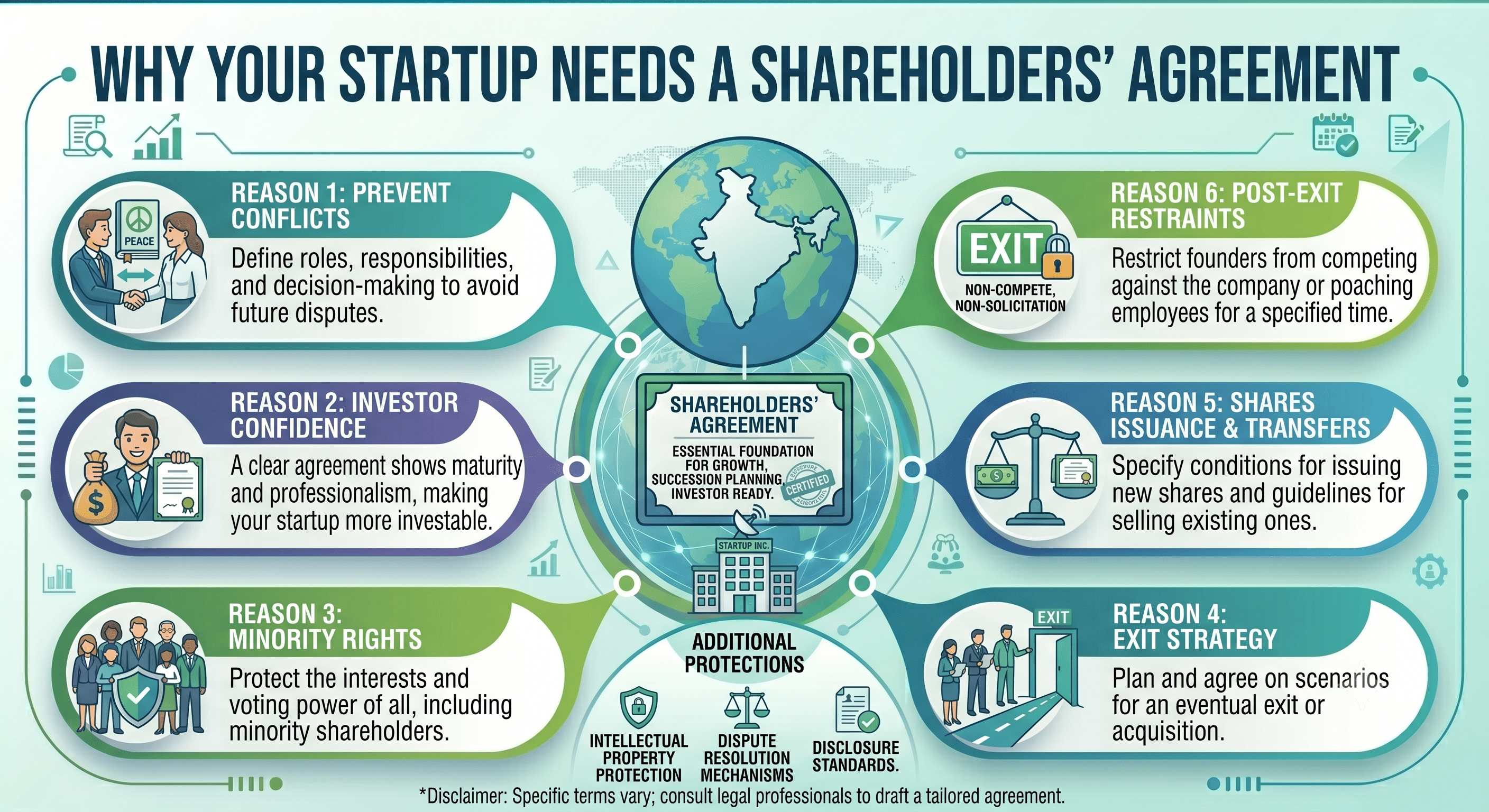
1. It Keeps Founders Aligned
When you are growing quickly, misunderstandings can easily arise. An SHA clearly defines who is responsible for what, how decisions are made, and what happens to a founder's shares if they decide to step away from the business.
2. It Protects Minority Shareholders
If you hold a smaller percentage of shares in the startup, you might worry about being outvoted on major corporate decisions. A well-crafted SHA includes protective provisions that require unanimous or majority consent for big moves, ensuring your voice is always heard.
3. It Prepares You for Venture Capital
Professional investors and venture capitalists will not write a check to a startup with messy internal relationships or vague equity rules. Having a robust, professional SHA in place shows investors that you take corporate governance seriously and have a clean, stable structure.
Key Clauses Every Startup Shareholders Agreement Must Have
A great Shareholders Agreement should be customized to your specific startup culture and long-term goals. However, there are several foundational clauses that business advisors always recommend including to safeguard your equity.
1. Founder Share Vesting (Reverse Vesting)
This is perhaps the single most important clause for early-stage startups. Share vesting ensures that founders do not walk away with a massive chunk of the company on day one.
Under a standard vesting clause, founders "earn" their shares over a set period, typically three to four years, with a one-year "cliff." If a co-founder leaves the startup after six months, they walk away with zero shares, and their unvested equity returns to the company. This protects the remaining founders who are staying to do the heavy lifting.
2. Right of First Refusal (ROFR) and Right of First Offer (ROFO)
You probably chose your co-founders very carefully. The last thing you want is for a shareholder to sell their shares to a complete stranger, or worse, a direct competitor.
● ROFR dictates that if a shareholder wants to sell their shares to an outside buyer, they must first offer those exact shares to the existing shareholders on the same terms.
● ROFO requires a selling shareholder to offer their shares to existing partners before even looking for an external buyer, keeping control of the company within your trusted circle.
3. Drag-Along and Tag-Along Rights
These twin clauses are designed to handle future acquisition opportunities smoothly.
● Drag-Along Rights: If a majority of shareholders (and the board) want to sell the company to an acquirer, they have the right to "drag" the minority shareholders along with them, forcing them to sell their shares on the same terms. This prevents a tiny shareholder from blocking a lucrative exit for everyone else.
● Tag-Along Rights: If a majority shareholder decides to sell their stake, minority shareholders have the right to "tag along" and sell their shares on the same terms, ensuring that smaller players are not left behind under a new, unwanted majority owner.
4. Pre-emptive Rights (Anti-Dilution Protection)
As your startup scales and raises new rounds of funding, new shares will be issued, which dilutes your ownership percentage. Pre-emptive rights give existing shareholders the opportunity to purchase a proportional number of shares in future funding rounds before they are offered to outsiders, allowing you to maintain your ownership stake if you have the capital to invest.
5. Deadlock and Dispute Resolution
What happens if the board is split fifty-fifty on a massive business decision and cannot move forward? A deadlock can paralyze a startup at a critical moment. Your SHA should clearly outline a dispute resolution mechanism, such as mediation or a structured buy-sell clause, to resolve stalemates quickly without resorting to expensive, public legal battles.
Why Navigating Startup Agreements with Business Advisors is Smarter?
It is incredibly tempting to download a free, generic Shareholders Agreement template online, fill in the blanks, and hope for the best. However, this is one of the most dangerous shortcuts a founder can take.
A poorly drafted clause can lead to accidental dilution, costly legal deadlocks, or a structure that repels potential investors.
This is where working with professional business consultants and corporate advisory experts in India becomes invaluable.
How Globaton Structures Your Legal Foundation?
● Tailored Clause Crafting: Our experienced business advisors do not use one-size-fits-all templates. We sit down with you to understand your startup's unique dynamics, drafting customized vesting and exit clauses that protect your specific interests.
● Investor-Ready Architecture: We structure your SHA to align with international venture capital standards, ensuring that future funding rounds can proceed with minimal legal friction.
● Holistic Corporate Governance: Beyond drafting the agreement, our team of company registration consultants ensures that your SHA is perfectly harmonized with your Articles of Association (AoA) and overall ROC compliances, creating a bulletproof legal framework.
Build a Safe, Strong, and Scaleable Startup with Globaton
A Shareholders Agreement is not about planning for failure; it is about setting clear, respectful rules that allow your startup to succeed with confidence. By addressing the tough questions early, you build a firm foundation of trust that keeps your team united through every high and low.
At Globaton, we are dedicated to simplifying the complex legal and compliance landscape for Indian startups. From drafting key agreements to managing your complete company registration and annual filings, our team of corporate advisory specialists acts as your strategic partners.
Protect your equity, your vision, and your peace of mind. Reach out to Globaton today to learn how our business advisors can help you draft a professional, robust Shareholders Agreement tailored to your startup's needs.
Frequently Asked Questions
How is a Shareholders Agreement (SHA) different from the Articles of Association (AoA)?
While both documents govern how a company is run, they serve very different legal purposes: -Articles of Association (AoA): This is a public document filed with the Registrar of Companies (ROC). It outlines the basic constitutional framework of the company, such as voting rights, share transfer processes, and board composition. It is generic and accessible to anyone. -Shareholders Agreement (SHA): This is a private, highly detailed contract between the shareholders. It can contain specific, confidential clauses (such as detailed vesting rules, custom dispute resolution terms, and investor protection clauses) that you would not want your competitors or the public to see. For maximum legal protection, our corporate advisory team always recommends amending your AoA to harmonize with your SHA so there are zero conflicts between the public and private rules.
Is a Shareholders Agreement legally mandatory for a registered startup in India?
Technically, the Companies Act does not legally force a Private Limited Company to have an SHA. You can register your company and operate using only your standard AoA. However, running a startup without an SHA is a massive risk. Without it, you have no legal mechanism to handle co-founder departures, unexpected equity deadlocks, or hostile share sales. Furthermore, institutional investors and venture capital firms will refuse to invest in your startup until a comprehensive, professional SHA is signed.
Why is founder share vesting (reverse vesting) so critical?
Vesting is the single most important clause for protecting co-founders. Imagine you and a partner launch a startup with a 50:50 equity split. After just 3 months, your partner decides to leave the company to take a high-paying corporate job, but they walk away holding half of your company's equity forever. This leaves you to do 100% of the work for only 50% of the reward, which makes the company impossible to fund or grow. Under a standard 4-year vesting schedule with a 1-year cliff: -The co-founder earns 25% of their allocated shares after completing their first full year (the cliff). -The remaining 75% of the shares are earned incrementally on a monthly or quarterly basis over the next 3 years. -If they leave before the 1-year cliff, they walk away with zero shares, and their unearned equity returns to the company pool.
What is the difference between ROFR and ROFO?
Both clauses are designed to prevent unwanted outsiders from buying shares in your company, but they work in slightly different ways: -Right of First Refusal (ROFR): If a shareholder finds an external buyer who offers to buy their shares at a specific price, the selling shareholder must first offer those shares to the existing shareholders at that same price and on the same terms. -Right of First Offer (ROFO): Before even looking for an external buyer, the selling shareholder must first ask the existing shareholders to make an offer. If the existing shareholders decline or offer too low, the seller can then look for an outside buyer, but they cannot sell to an outsider at a lower price than what was offered internally.
Why do venture capital investors insist on Drag-Along and Tag-Along rights?
These clauses protect different groups of shareholders during an acquisition or exit: -Drag-Along Rights (Investor/Majority Protection): If a buyer wants to purchase 100% of your startup, a tiny shareholder holding only 1% of the equity could block the entire deal. Drag-along rights allow a defined majority of shareholders to "drag" the minority along, forcing them to sell their shares on the same terms. -Tag-Along Rights (Minority Protection): If a majority shareholder decides to sell their stake, a minority shareholder might worry about being stuck with a new, unknown owner. Tag-along rights allow the minority shareholders to "tag along" and force the buyer to purchase their small stake on the exact same terms as the majority.
Can we draft and sign a Shareholders Agreement after our company is already registered?
Yes, absolutely. While it is ideal to execute an SHA during incorporation, you can sign one at any point during your startup's lifecycle. If you are currently operating without an SHA, it is highly advisable to consult with startup legal advisors to draft one before your business gains significant valuation or before you begin pitching to external investors.
What happens if the board is split fifty-fifty on a major decision?
A split vote on a critical issue (such as raising debt, changing core business directions, or hiring a key executive) is called a deadlock. A well-crafted SHA drafted by professional business consultants includes a specific deadlock resolution clause. This might involve: -The Chairman's Casting Vote: Giving a designated chairperson the deciding vote. -Structured Mediation: Submitting the issue to an external panel of trusted advisors. -A Buy-Sell Clause: Allowing one co-founder to buy out the other co-founder's shares at a fair market value to resolve the deadlock permanently. Without these clauses, a deadlock can freeze your business operations and lead to expensive, public court battles.
Can we just use a free Shareholders Agreement template we found online?
Downloading a free template is one of the most dangerous shortcuts an early-stage startup can take. Standard online templates are often built on international laws (like US or UK law) that are invalid in India. Furthermore, they are not customized to your unique startup culture, equity splits, vesting timelines, or industry-specific compliance requirements. A single poorly drafted or missing clause can lead to accidental dilution, tax liabilities, or legal disputes that can ruin your business.