If there is one thing that keeps startup founders awake at night (besides cash flow and product launches), it is the word "compliance."
For Private Limited Companies in India, the annual ritual of submitting documents to the Registrar of Companies can feel like trying to solve a puzzle where the pieces keep shifting. The Ministry of Corporate Affairs portal is full of forms, terms like "AGM" and "Auditor’s Report" get thrown around, and missing a deadline can result in hefty daily penalties.
However, annual ROC filing does not have to be a stressful ordeal. When you break it down into logical steps, it becomes a highly manageable routine that actually strengthens your company's financial health.
Let us walk through the exact step-by-step journey of your annual ROC filings, written in plain English, so you can navigate the compliance season with absolute confidence.
 Why Do We Do This Every Year?
Before diving into the steps, it helps to understand the "why."
Annual ROC filings are not just bureaucratic busywork. They are your company’s way of saying to the government, your investors, and your customers that your business is transparent, active, and healthy. Think of it as an annual physical exam for your startup’s legal structure. Keeping your records updated keeps your limited liability protection intact and makes you look incredibly professional when investors come knocking.
Here is the step-by-step map to getting your filings done flawlessly.
Step 1: Polish and Audit Your Financial Books
Every great annual filing begins with solid bookkeeping. You cannot file your returns until your accounts for the financial year (which runs from April 1st to March 31st) are locked and finalized.
● Assemble Your Books: Collect all invoices, bank statements, receipts, and payroll records.
● Bring in the Auditor: Every registered company must have a statutory auditor. Your auditor will examine your books, ensure everything complies with Indian Accounting Standards, and prepare the crucial Auditor's Report.
● Pro-Tip: Do not wait until August to start this. Work with your business consultants early in April or May to get your books in order so your auditor has plenty of time to work.
Step 2: Draft the Director’s Report
While the auditor is busy checking your numbers, your board of directors must prepare the Director's Report.
This document is a formal narrative of your startup's journey over the past year. It outlines your business performance, any major shifts in your industry, future growth plans, corporate social responsibility initiatives, and details about share allocations. It serves as the official story behind the financial numbers, giving context to anyone reviewing your company's filings.
Step 3: Convene the Annual General Meeting (AGM)
The AGM is a mandatory annual gathering where your shareholders, directors, and auditors come together to review the company's performance.
● The Timeline: For most startups, the AGM must be held on or before September 30th following the end of the financial year.
● The Agenda: During this meeting, the shareholders formally adopt the audited financial statements, approve the Director's Report, and confirm the appointment or reappointment of auditors if needed.
● The Record: Make sure your team takes detailed minutes of the meeting, as these are critical legal documents that you must maintain in your corporate records.
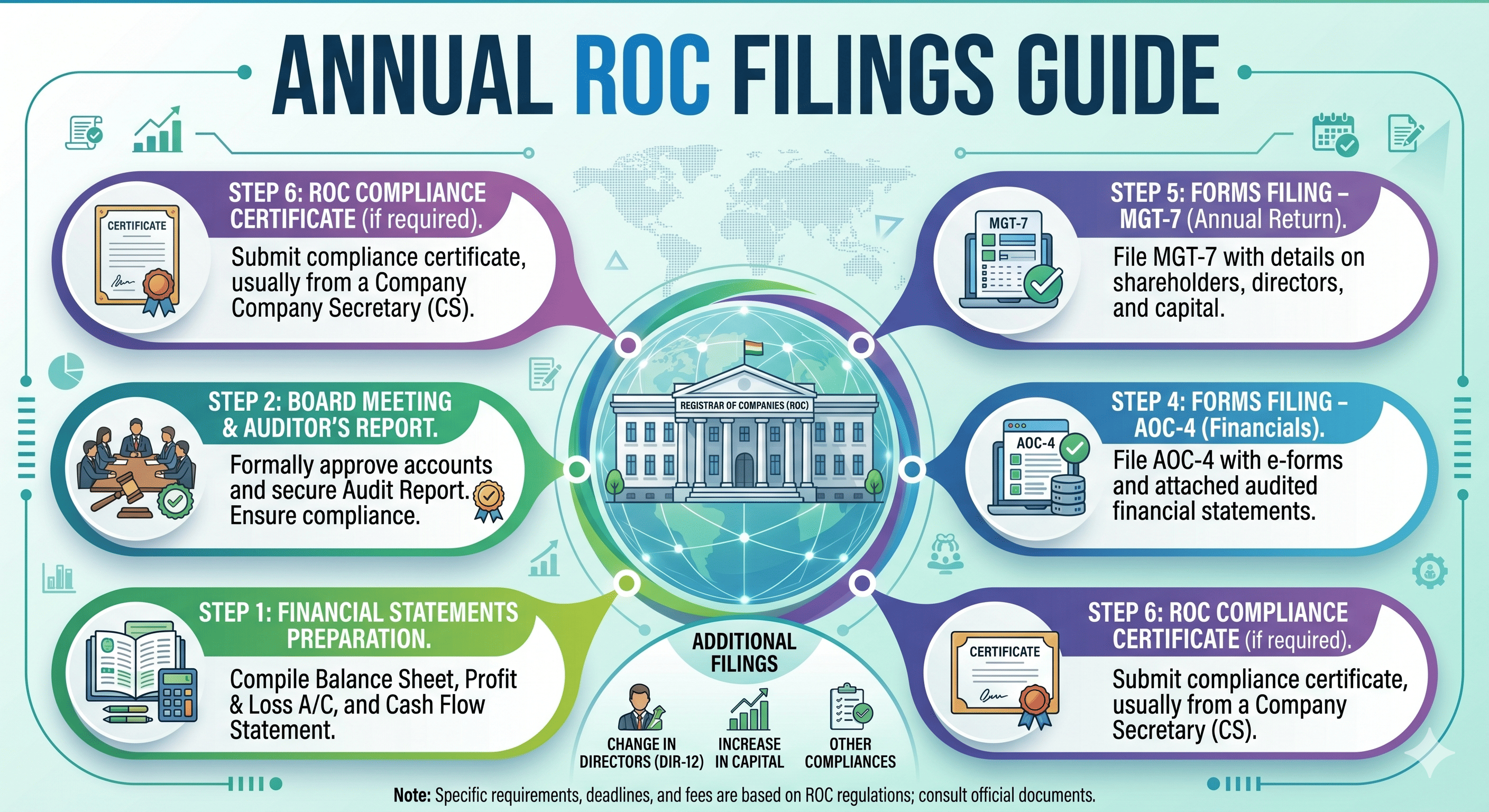
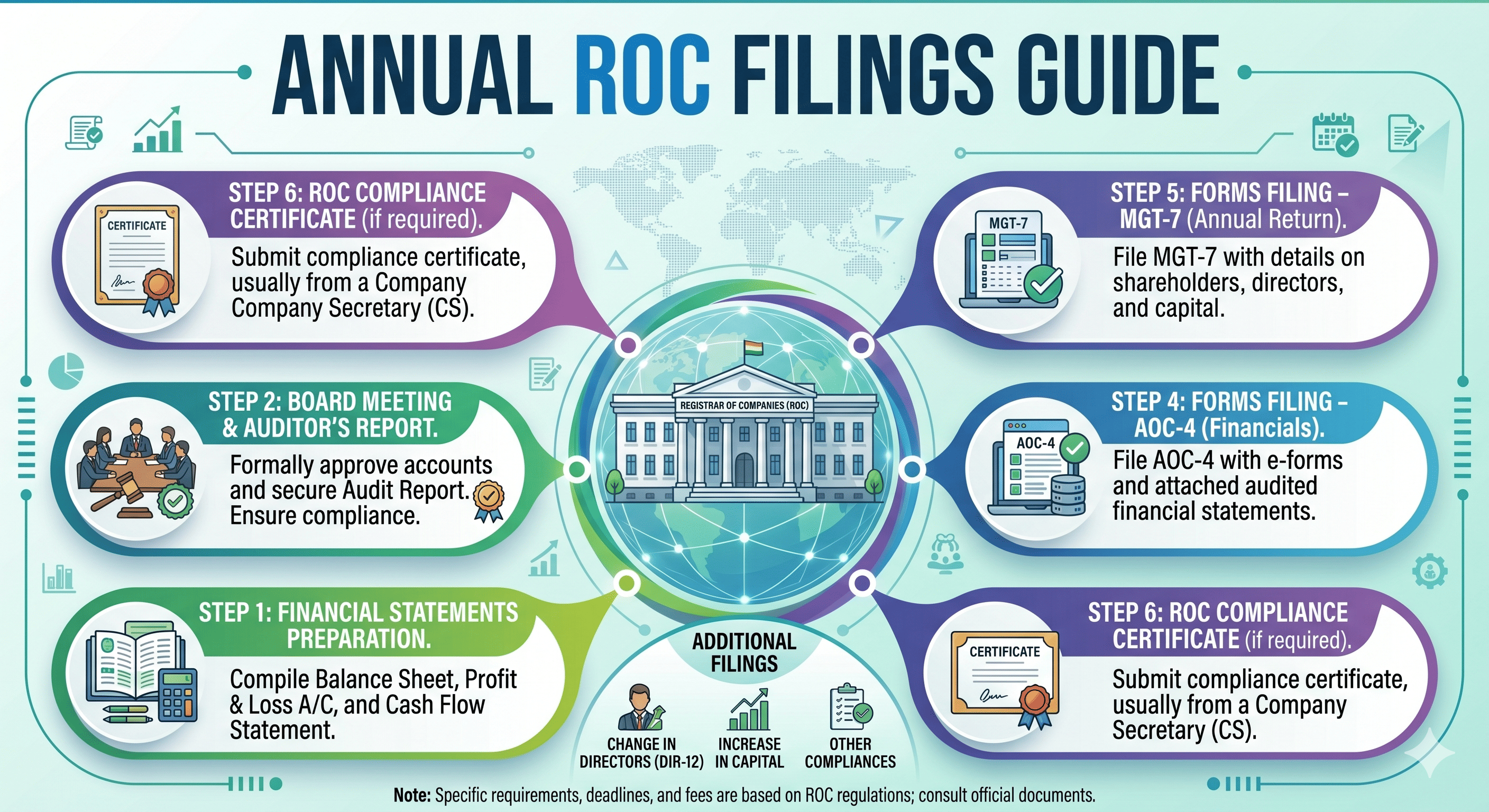
Step 4: Submit Your Financial Statements (Form AOC-4)
Once the financial statements are formally approved at the AGM, it is time to submit them to the government. This is done using Form AOC-4.
● What goes inside: You will upload your audited balance sheet, profit and loss account, director's report, and the auditor's report.
● The Deadline: Form AOC-4 must be filed within 30 days of holding your AGM. If your AGM was held on September 30th, your deadline is October 30th.
● Why it matters: This form is public. Anyone looking up your company on the MCA portal (including potential investors or corporate partners) will look at this filing to assess your financial stability.
Step 5: File Your Annual Return (Form MGT-7 or MGT-7A)
With your financial health successfully reported, your next task is to update the ROC on your corporate structure. This is handled through Form MGT-7 (or MGT-7A for small businesses and One Person Companies).
● What goes inside: This form details your registered office address, lists of shareholders, any transfers of shares that occurred during the year, details of board meetings held, and directory signatures.
● The Deadline: Form MGT-7 must be filed within 60 days of your AGM. If your AGM was held on September 30th, your deadline is November 29th.
● Why it matters: It acts as an official census of your company's ownership and management, ensuring no unauthorized structural changes are made.
Step 6: Complete Director Verification (DIR-3 KYC)
While not technically a company filing, this is an essential compliance step for the individuals running the startup. Every individual who holds a Director Identification Number (DIN) must complete their KYC verification every year.
● The Deadline: This must be completed by September 30th each year.
● The Risk: If a director fails to complete this verification, their DIN status is marked as "Deactivated" and they cannot sign off on any corporate filings, effectively putting your company’s administrative processes on hold.
The Smart Route: Why DIY Compliance is a Growth Trap
As a founder, your time is your most valuable currency. Spending dozens of hours reading complex guidelines, calculating filing fees, and wrestling with government upload portals is simply not a great use of your energy. A single missed checkbox can lead to compounding late fees or red flags on your company's public records.
Partnering with professional corporate advisory services in India offers immense benefits:
● Total Peace of Mind: Expert business advisors track all your deadlines and changes in MCA laws, ensuring you never face a late fee.
● Flawless Documentation: Experienced business consultants help draft precise board resolutions, director reports, and minutes that protect your interests.
● Investor Readiness: Having professionals manage your compliance means your books are permanently tidy, making future funding rounds incredibly smooth.
Keep Your Startup Compliant and Growing with Globaton
Annual ROC filings do not have to be a source of stress. When approached systematically with the right partners, they are simply a natural part of running a successful, respected company.
At Globaton, we act as your dedicated compliance department. Our team of skilled company registration consultants, corporate advisory experts, and business advisors handle every stage of your annual filing journey, from bookkeeping and auditing coordination to final MCA submission.
Let us protect your legal foundation so you can focus entirely on scaling your business. Contact Globaton today to schedule a compliance health check for your startup.
Frequently Asked Questions
What are the exact deadlines for filing Form AOC-4 and Form MGT-7?
Your filing timelines are directly linked to the date of your Annual General Meeting (AGM). The standard deadlines are calculated as follows: Form AOC-4 (Financial Statements): This form must be submitted within 30 days from the date of your AGM. For example, if you hold your AGM on September 30th, your final filing deadline is October 30th. Form MGT-7 or MGT-7A (Annual Return): This form must be filed within 60 days from the date of your AGM. If your AGM was held on September 30th, your final filing deadline is November 29th. Our business advisors always recommend holding your AGM early in September to give your team plenty of breathing room to upload these documents.
We registered our startup late in the financial year. Do we still need to file ROC returns?
Under the Companies Act, 2013, if your startup was incorporated on or after January 1st, you have a unique administrative choice. You can choose to extend your first financial year to March 31st of the following calendar year. This means that if your company was registered on February 5th, you do not have to close your books on March 31st of that same year. Instead, you can close your first financial year on March 31st of the following year (covering a period of roughly 14 months). If you choose this extension, your first annual ROC filings will be due after your extended financial year ends. Our company registration consultants can review your incorporation date to confirm if you qualify for this helpful extension.
What happens if our startup has zero revenue or business transactions?
This is one of the most common pitfalls for early-stage founders. Even if your startup had zero transactions, zero revenue, and zero operational activity, you are still legally required to maintain compliance. You must hold a formal AGM, have a statutory auditor prepare an audit report, and file "nil" returns for both Form AOC-4 and Form MGT-7 (or MGT-7A). Failing to do so will still trigger daily penalties and can damage your company's active status.
What are the penalties if we miss the filing deadlines?
The Ministry of Corporate Affairs is very strict about deadlines. If you miss the timeline for filing Form AOC-4 or Form MGT-7, you will face an immediate, automatic late fee of 100 rupees per day, per form. If you delay your filings for 2 consecutive years, the consequences become significantly worse: the ROC has the legal power to strike off your startup from the official register and disqualify your directors from starting or managing any other company in India for up to 5 years.
Can a director sign and submit ROC forms if they have not completed their DIR-3 KYC?
No. Every director must complete their DIR-3 KYC verification on or before September 30th every year. If a director fails to meet this deadline, the Ministry of Corporate Affairs will automatically mark their Director Identification Number (DIN) as "Deactivated." A director with a deactivated DIN is legally blocked from signing or uploading any corporate forms, which completely freezes your company's administrative processes until the KYC is resolved and a reactive penalty of 5,000 rupees is paid.
Do we need to physically visit the ROC office to submit these annual returns?
No, the entire annual ROC filing process is 100% online. All documents and forms are uploaded digitally through the Ministry of Corporate Affairs (MCA) V3 portal. To sign and secure these forms, your directors and authorized professionals (such as a practicing Company Secretary or Chartered Accountant) must use valid Class 3 Digital Signature Certificates (DSC).