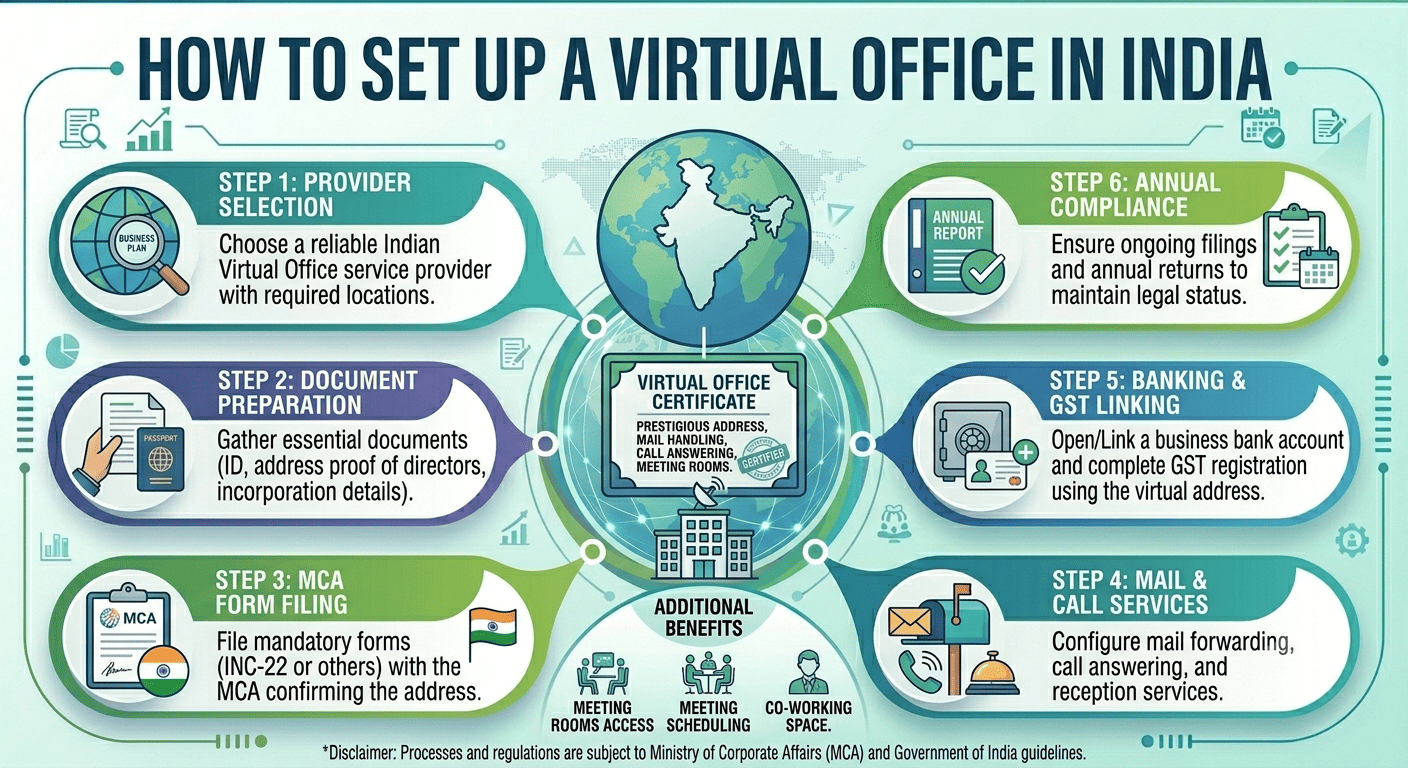
Building a modern startup looks very different today than it did a decade ago. With remote-first
work cultures, digital-first products, and team members scattered across different states, renting
a physical office space in a premium commercial hub like Bangalore, Gurgaon, or Mumbai is
often an unnecessary financial drain. Why lock up precious capital in heavy security deposits
and monthly rent when your team works beautifully from their living rooms?
This shift has made virtual offices one of the most popular strategies for young businesses.
However, a big question often stops founders in their tracks: "Can I actually use a virtual office
to legally register my company and get a GST number in India?"
The short answer is yes. But because Indian regulatory bodies have become incredibly strict
about verifying business addresses to prevent tax evasion, doing this correctly requires careful
navigation. Let us break down how to set up a virtual office that is 100 percent compliant with
both the Registrar of Companies (ROC) and the Goods and Services Tax (GST) network.
The Legal Truth: Is a Virtual Office Allowed?
Before we jump into the setup, let us clear up the legal compliance side of things.
Under Section 12 of the Companies Act, 2013, every business registered in India must have a
"registered office" capable of receiving and acknowledging official communications. Similarly,
the GST system requires a "principal place of business" where your financial books and records
are accessible.
The law does not state that you must physically sit in this office every single day.
What the government cares about is traceability. They want to know that the address is real,that you have a legal right to use it, and that any official letters or notices sent there will actually
reach you. As long as your virtual office provider meets these specific needs, your setup is
completely legal and valid.
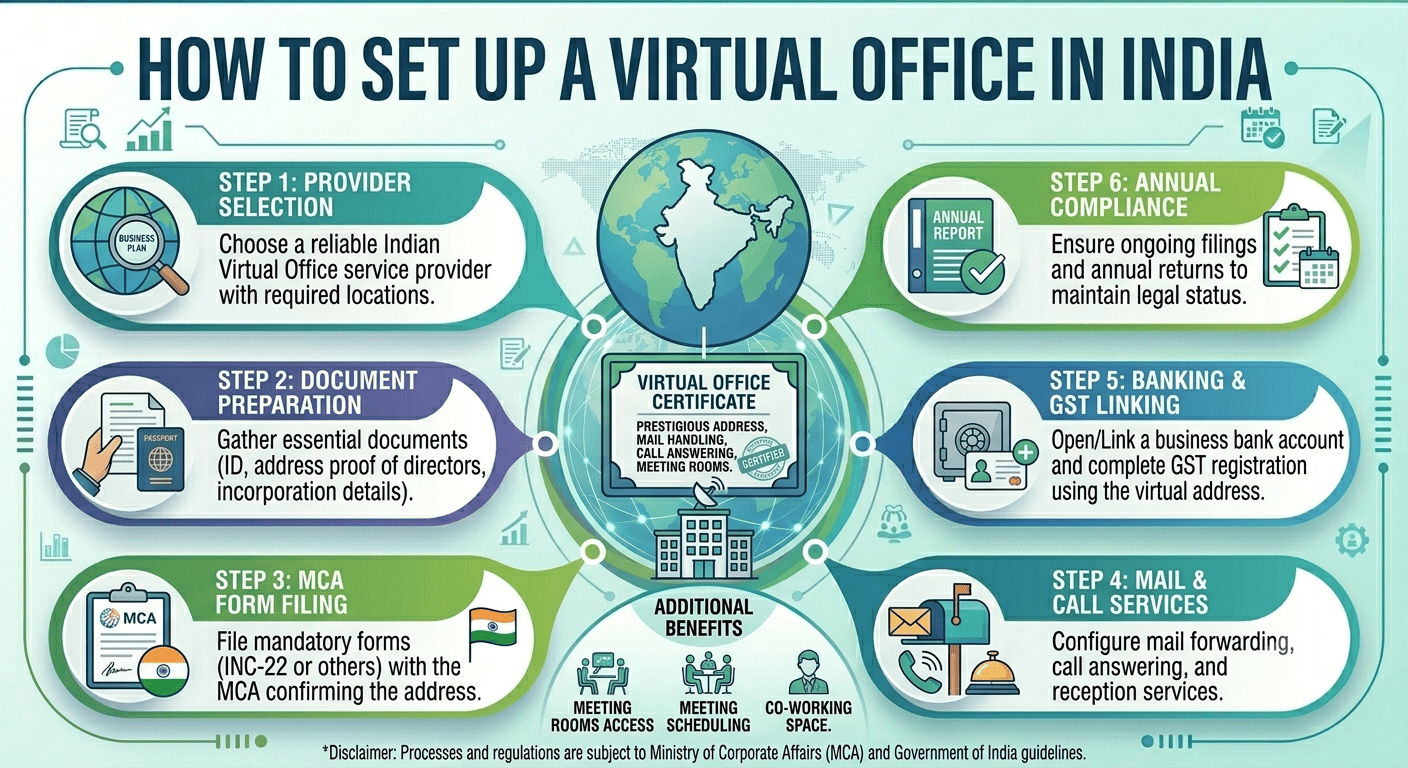
Step 1: Partner with a Legitimate, Verification-Ready
Provider
The biggest mistake a founder can make is choosing the cheapest virtual office option they find
online. Many budget-friendly, "address-only" services simply provide a mailbox without any real-
world support.
If a GST officer decides to conduct a surprise physical verification visit and finds a locked,
empty room with no trace of your business, your registration will be cancelled immediately.
When selecting a provider, make sure they offer:
● Active Mail Handling: They must receive, scan, and quickly forward any government
letters or tax notices to you.
● Physical Presence Support: They should have a receptionist or physical representative
on-site during business hours to assist government officials.
● Signage and Name Boards: They must display your company's name on a physical
directory or digital board at the entrance, which is a mandatory legal requirement.
Step 2: Secure the "Big Three" Compliance
Documents
Once you choose a reliable provider, they must issue a specific set of compliance documents.
You will need these to complete your filings on the MCA and GST portals.
1. The No Objection Certificate (NOC)
This is a formal letter from the property owner or the primary tenant stating they have no
objection to your startup using their address as its registered office. The NOC must be printed
on the provider's official letterhead and must clearly state your exact company name.
2. The Notarized Rent or Service Agreement
This is the formal contract between your startup and the virtual office provider. It proves you
have legally acquired the right to use the space. To prevent red flags during verification, this
agreement should ideally have a minimum term of 12 months.
3. A Recent Utility Bill
You must submit a copy of a utility bill (such as electricity, water, or telephone) for the property.
This bill must not be older than two months from the date of your filing, and the address on the
bill must match the address on your rent agreement and NOC down to the very last comma.Step 3: File Your Incorporation with the ROC
With your virtual office documentation ready, you can proceed with registering your business
through the Ministry of Corporate Affairs (MCA) portal.
Your company registration consultants will upload the NOC, rent agreement, and utility bill as
proof of your registered office address using the SPICe+ integration form.
During this step, accuracy is everything. Even a tiny mismatch in the PIN code, building number,
or floor details between your application and the utility bill can cause the ROC to reject your
application, delaying your incorporation by weeks.
Step 4: Secure Your GST Registration (And Prepare
for Verification)
Once your company is incorporated, you can apply for your GST number using the same virtual
office address.
Because the GST network has faced issues with fraudulent registrations, physical verification
visits are increasingly common for new businesses, even if you complete Aadhaar
authentication.
Here is how to ensure your virtual office passes a GST inspection:
● Consistency is Key: The business name and address entered on the GST portal must
match your incorporation documents exactly.
● The Nameplate Test: Ensure your virtual office provider has installed your startup's
physical name board at the premises before the officer arrives.
● Alert Your Provider: Let your virtual office team know as soon as your GST application is
submitted. If an officer visits, the on-site staff must be ready to present your lease
agreement and explain how your business operates.
Why Navigating This with Business Consultants is
Safer
While setting up a virtual office sounds straightforward on paper, the practical realities of dealing
with government portals and tax officers can be highly stressful. A single administrative error
can lead to a rejected GST application or, worse, a compliance notice.
This is where working with professional business advisors and corporate advisory experts in
India becomes a game-changer.
How Globaton Protects Your Setup:
● Vetted Virtual Office Partners: We connect you with verified, high-quality virtual office
providers across India who have a proven track record of passing physical GST
inspections.● End-to-End Document Review: Our experienced business consultants thoroughly audit
every line of your NOC, rent agreement, and utility bills before submission to ensure zero
mismatches.
● Coordinated Support: We manage the entire interaction with both the ROC and GST
authorities, guiding you on how to respond to queries and handling compliance
requirements on your behalf.
Scale Smartly and Compliantly with Globaton
A virtual office is one of the smartest operational strategies for modern, lean startups. It gives
you the prestige of a prime business address and complete legal compliance at a fraction of the
cost of physical real estate.
At Globaton, we are dedicated to simplifying your business journey. From initial virtual office
selection to company registration and GST approvals, our team of skilled company registration
consultants and business advisors handle every regulatory hurdle with precision.
Let us build a strong, flexible, and completely compliant foundation for your startup. Reach out
to Globaton today to set up your virtual office seamlessly
Frequently Asked Questions
Is it really legal to register a company using a virtual office in India?
Yes, it is completely legal. Under Section 12 of the Companies Act, 2013, your startup must have a registered office address where official communications can be sent and acknowledged. The law does not mandate that your employees must work from that physical space every day. As long as your virtual office provider is a legitimate entity that provides a valid tenancy agreement, a No Objection Certificate (NOC), and utility bills, the Registrar of Companies (ROC) will accept the address for company incorporation.
Can I get a GST registration using a virtual office address?
Yes, you can. The Goods and Services Tax (GST) law allows businesses to register using a virtual office as their "principal place of business". However, because the GST department is highly vigilant about preventing tax fraud, they scrutinize virtual office applications carefully. To secure your GST registration smoothly, your virtual office provider must be cooperative and ready to support you during physical verification visits. Partnering with professional company registration consultants ensures you choose a premium, verification-ready provider to avoid application rejection.
What documents do I need from my virtual office provider for registration?
To complete your filings on the MCA and GST portals, you must obtain 3 mandatory compliance documents from your provider: - A Notarized Rent or Lease Agreement: This contract must be in your company's name (or the founder's name if the company is not yet incorporated) and should ideally have a term of at least 12 months. - A No Objection Certificate (NOC): A formal letter on the owner's letterhead stating they permit your company to use the address. - A Utility Bill: A recent electricity bill, water bill, or landline telephone bill. This bill must be less than 2 months old, and the address must match your lease agreement exactly.
What happens during a physical GST verification at a virtual office?
During a physical verification, a GST officer will visit the virtual office address to confirm that your business is genuine. The officer will check: - Physical Signage: Your company's name must be displayed on a physical board or directory at the entrance of the building. - Document Verification: The on-site staff must be able to present your original rent agreement, NOC, and company incorporation documents if requested. - Operational Authenticity: The officer will ask the desk staff about your business activities and how to contact you. High-quality virtual office providers have on-site receptionists specifically trained to assist officers and handle these verification visits successfully.
What happens if a government notice is mailed to my virtual office?
A premium virtual office service includes active mail handling. When a government letter, tax notice, or bank communication arrives, the on-site team receives and signs for it on your behalf. They will then scan the document and email it to you within 24 to 48 hours, or forward the physical copy to your residential address. This ensures you never miss a critical compliance deadline, keeping your startup fully compliant with all corporate advisory standards.
Can I register a virtual office in a state where I do not physically live?
Yes, you can. This is a common strategy for e-commerce sellers and service providers who want to expand their operations to other states or open a branch office. For example, if your team is based in Delhi but you want a prestigious corporate address in Karnataka for tax and client purposes, you can easily set up a virtual office for GST registration in Bangalore. Our team at Globaton can help you set up compliant virtual addresses across multiple states in India.