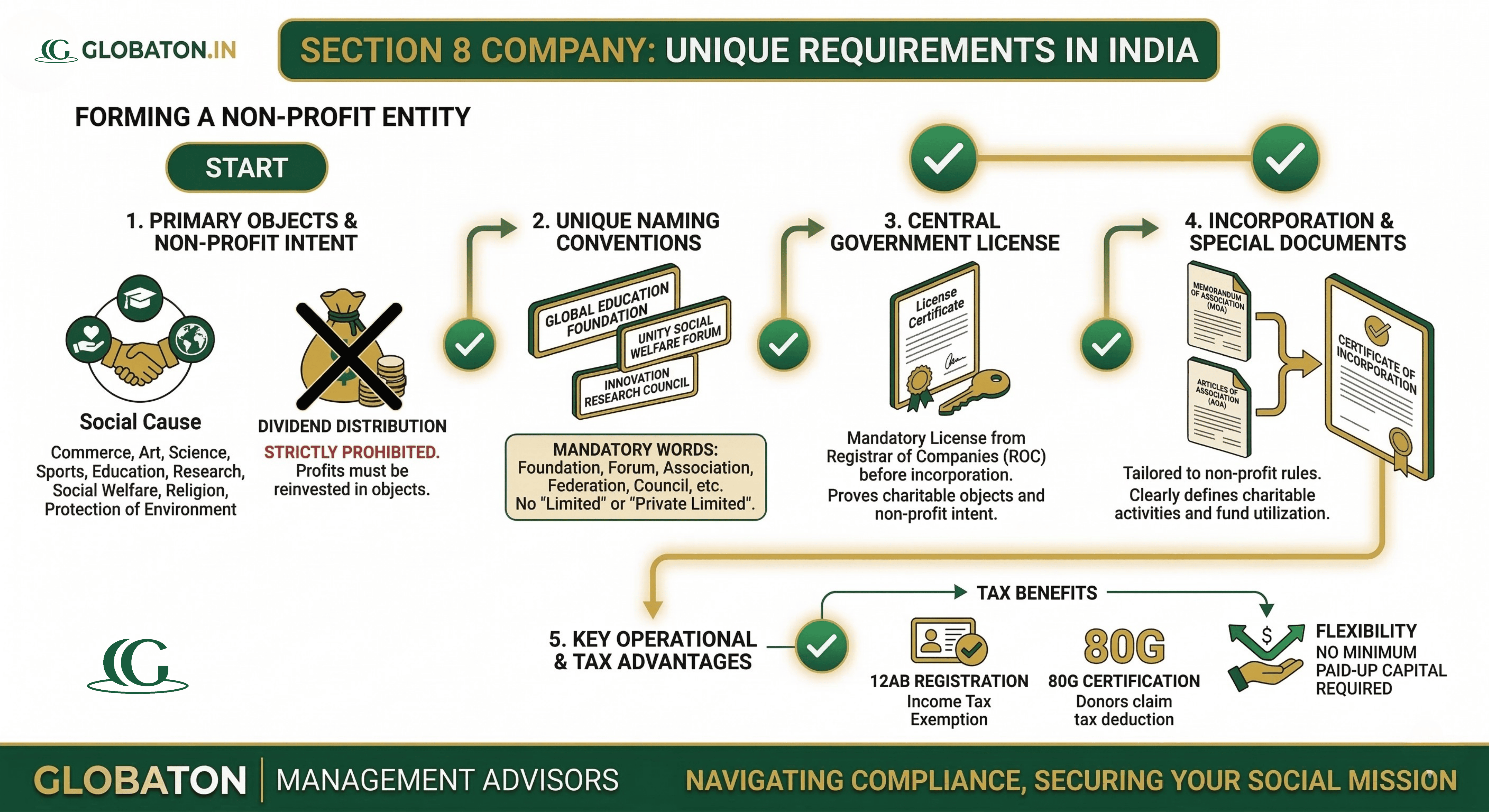
Creating a non-profit organisation in India is a noble endeavour, but it comes with a specific set of regulatory keys. The most common structure for this is a Section 8 Company, governed by the Companies Act, 2013. While it offers the benefits of a corporate structure, like limited liability and separate legal entity status, it also demands compliance with unique requirements that differ significantly from standard private or public limited companies.
At Globaton, we understand the passion that drives social entrepreneurs. We also understand the complexities they face. This guide breaks down the critical special requirements you must navigate to successfully establish and operate a Section 8 Company.
The Foundation: Charitable Objects and Non-Profit Intent
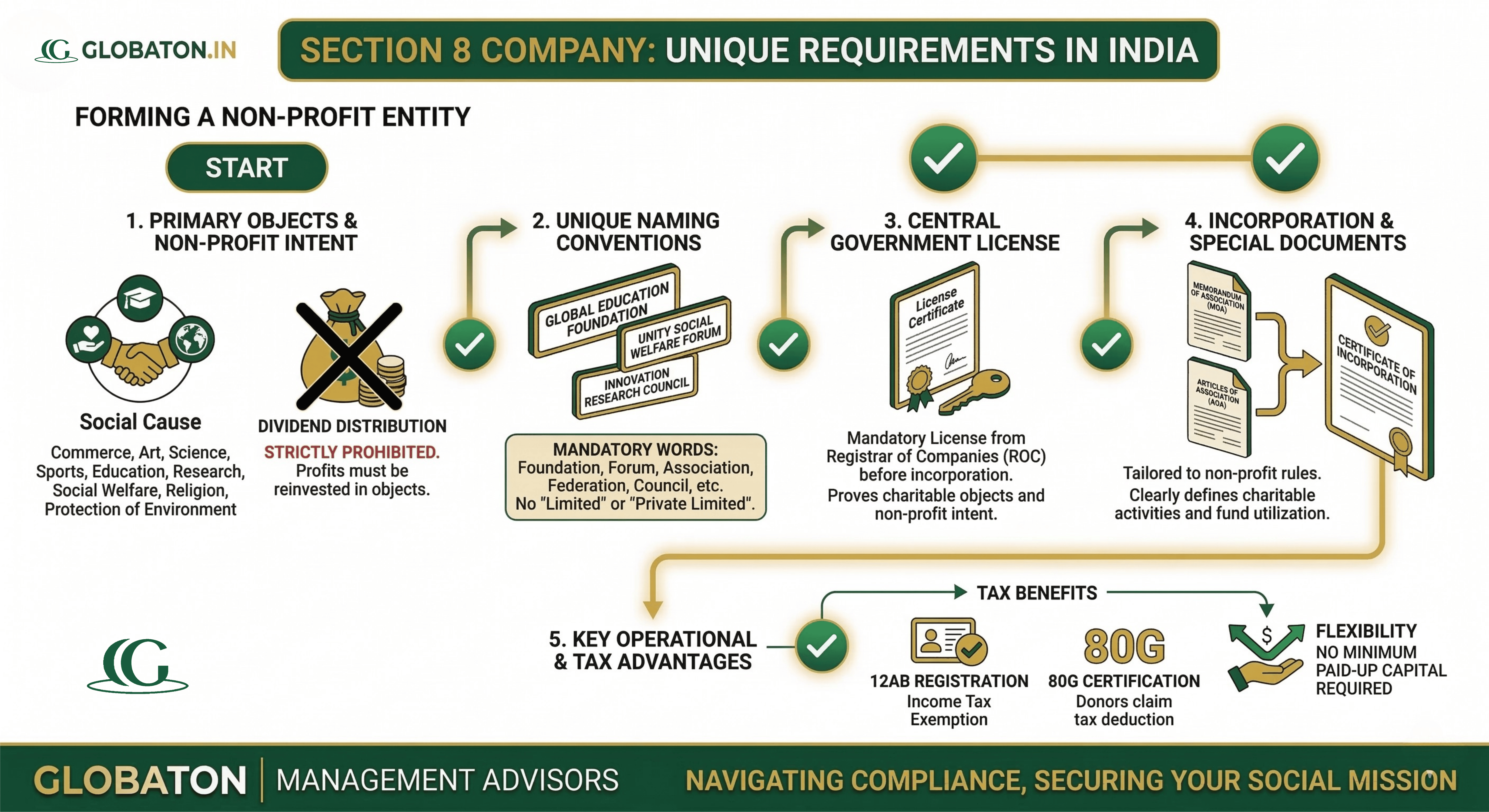
The very definition of a Section 8 Company hinges on its purpose. Its core objective must be the promotion of commerce, art, science, sports, education, research, social welfare, religion, charity, protection of environment or any such other object.
Crucially, this purpose must be entirely non-profit. The company cannot have any intention of distributing dividends or profits to its members. Every rupee earned or donated must be ploughed back into achieving these defined charitable objects. This "non-distribution constraint" is the absolute cornerstone of Section 8 status.
The Name Game: Unique Naming Conventions
Unlike regular companies that must end with "Limited" or "Private Limited," Section 8 Companies have their own set of mandatory words. To clearly signify their charitable nature to the public, the name must include words like Foundation, Forum, Association, Federation, Chambers, Confederation, Council, Electoral Trust, etc. The Central Registration Centre (CRC) is strict about this, and getting your name approved is the first hurdle.
Seeking Permission: The Central Government License
Forming a Section 8 Company isn't just about filing incorporation documents. You must explicitly apply for and receive a license from the Central Government (delegated to the Registrar of Companies). This license is essentially proof that the government has verified your non-profit intent and charitable objects and allows you to function with certain privileges. Obtaining this license is a mandatory prerequisite before you can proceed with the standard incorporation process.
 The Charter Documents: Tailored MOA and AOA
The Memorandum of Association (MOA) and Articles of Association (AOA) are the constitution of any company. For a Section 8 Company, these documents require special attention. They must strictly reflect the non-profit nature and prohibited dividend distribution. The objects clause in the MOA must precisely define the charitable activities the company will undertake, and the AOA must detail rules that ensure funds are used solely for these purposes. Any deviation or ambiguity here can lead to license revocation.
Board Composition: Specific Director Rules
While a minimum number of directors is required (two for a private-like Section 8, three for public-like), there are specific nuances to board composition. A partnership firm can be a member (shareholder) of a Section 8 Company, which is unique. Also, while standard residency requirements apply, the overall structure of the board should demonstrate a commitment to the defined social cause rather than commercial interests.
Capital Structure: Minimum Capital and Flexibility
Unlike some other company types, there is no minimum paid-up capital requirement for a Section 8 Company. This provides significant flexibility, especially for initial setups where funding might be limited. This absence of a minimum capital barrier encourages the formation of non-profits by reducing initial financial hurdles.
Tax Benefits: Unlocking Potential
One of the major incentives for forming a Section 8 Company is the potential for tax exemptions. While incorporation alone doesn't grant tax breaks, the company can apply for specific certifications under the Income Tax Act, 1961. Securing 12AB registration allows the company's income to be exempt from tax, and obtaining 80G certification enables donors to claim tax deductions on their contributions, significantly boosting fundraising potential. These certifications involve a separate application process and require demonstrating ongoing charitable activities.
Ongoing Vigilance: Stringent Compliance and Reporting
Section 8 Companies are subject to rigorous ongoing compliance. They must maintain meticulous books of account and undergo a mandatory annual audit by a Chartered Accountant. Annual filings, including financial statements and annual returns, must be submitted to the Registrar of Companies. Importantly, the government closely monitors these companies to ensure that funds are utilized only for the defined charitable objects and that no profits are diverted. Failure to comply can lead to severe penalties, including license cancellation and forceful winding up.
Strategic Planning: No Conversion and Limited Investment
Operating a Section 8 Company also means understanding its limitations. Generally, a Section 8 Company cannot be converted into any other type of company. Furthermore, there are restrictions on making investments in other body corporates, especially if such investment goes against the non-profit principle. This ensures the company remains dedicated to its primary mission.
How Globaton Can Help?
Navigating these special requirements demands expertise and precision. At Globaton, we provide comprehensive end-to-end support for social entrepreneurs. From initial object defining and name reservation to securing the crucial Central Government license, drafting tailored MOA/AOA, and facilitating tax certifications, our team guides you through every step. We ensure rigorous compliance so you can focus entirely on making a meaningful impact.
Frequently Asked Questions
Can a Section 8 Company ever distribute profits to its members?
No, absolutely not. The fundamental requirement of a Section 8 Company is its non-profit intent. Any profits generated or funds received must be strictly used to achieve its charitable objectives, and dividend distribution is prohibited.
What is the minimum capital required to start a Section 8 Company?
There is no minimum paid-up capital requirement for incorporating a Section 8 Company. This flexibility is designed to encourage the formation of non-profit organisations.
Is it mandatory for a Section 8 Company to have words like "Foundation" in its name?
Yes, it is. Unlike standard companies ending with "Limited," Section 8 Companies must include words such as Foundation, Forum, Association, Federation, Council, etc., to signify their charitable nature.
How does a Section 8 Company get tax exemptions?
Incorporating as Section 8 doesn't automatically grant tax breaks. The company must separately apply for 12AB registration for income tax exemption and 80G certification to enable donors to claim tax deductions on their contributions.
Can a standard private limited company convert into a Section 8 Company?
Yes, a regular private or public limited company can convert into a Section 8 Company, provided it alters its objects clause to align with charitable purposes and satisfies all other non-profit requirements. However, the reverse conversion (Section 8 to regular company) is generally not permitted.