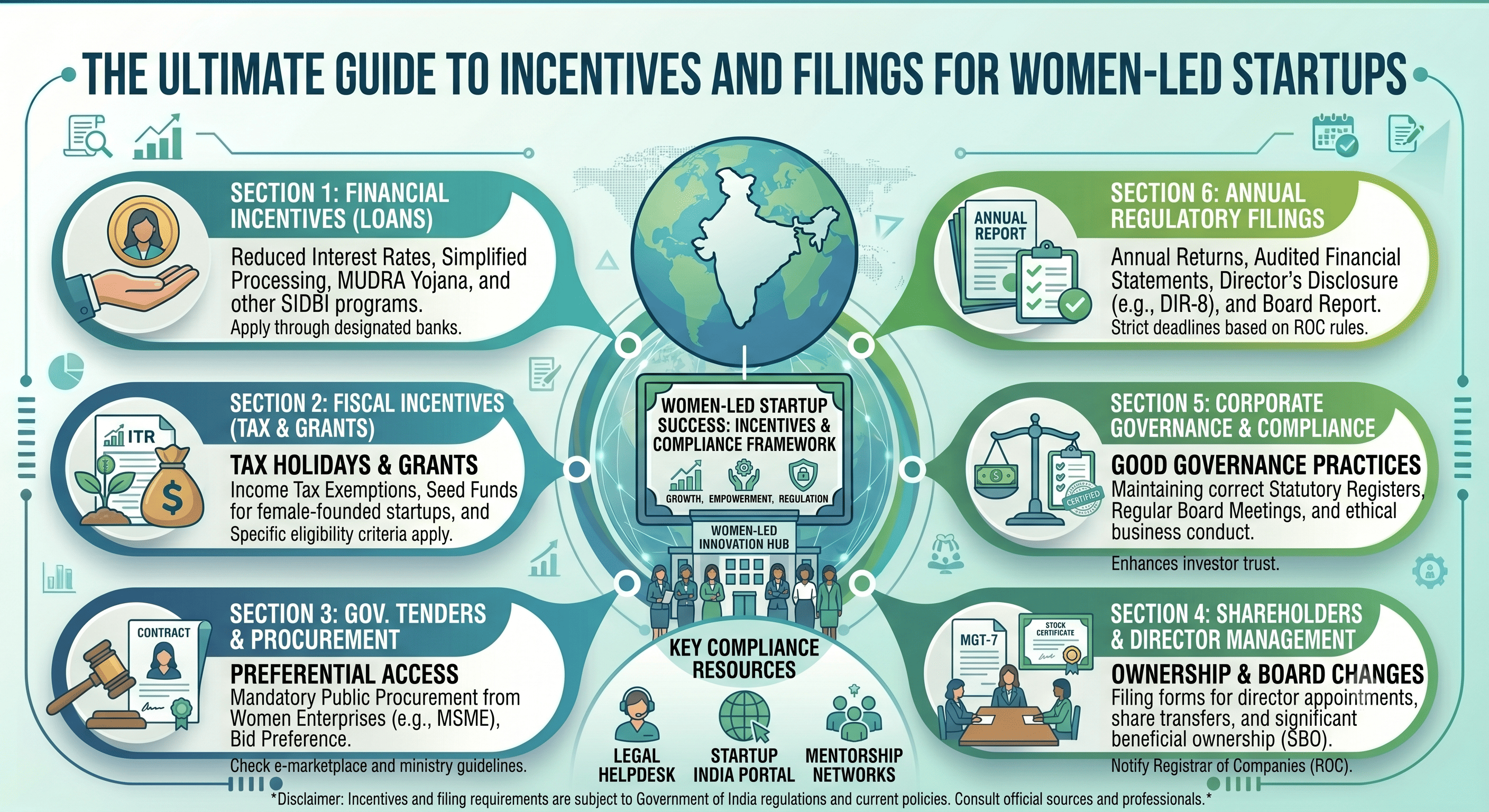
The entrepreneurial landscape in India is undergoing a massive, inspiring transformation. Today, women are not just participating in the startup ecosystem; they are driving it forward with record venture capital funding, highly scalable business models, and unparalleled execution. From fintech and health-tech to sustainable consumer goods, women-led startups are proving to be the backbone of the modern Indian economy.
Recognizing this incredible potential, both the government and financial institutions have rolled out a powerful suite of subsidies, low-interest loans, and market-access schemes specifically designed for female founders.
However, accessing these life-changing opportunities is not as simple as having a great idea.
To qualify for these special incentives, your startup must be structured correctly and meet strict legal definitions. Let us walk through the most valuable government schemes for women entrepreneurs, the essential corporate filings you need to maintain, and how strategic planning can help you claim every benefit you deserve.
What Exactly Qualifies as a "Women-Led" Startup?
Before applying for any government or bank incentive, it is crucial to understand the legal criteria. While different programs have slight variations, the baseline standard in India is very clear.
To qualify as a woman-led enterprise, a female founder (or a group of female co-founders) must hold at least 51% of the total share capital or partner equity. Additionally, the day-to-day management and decision-making control of the business must rest in the hands of women.
For some global programs, such as the TiE Women platform, the equity threshold for co-founders is relaxed to a minimum of 33%, but for most Indian government-backed schemes, the 51% rule is non-negotiable.
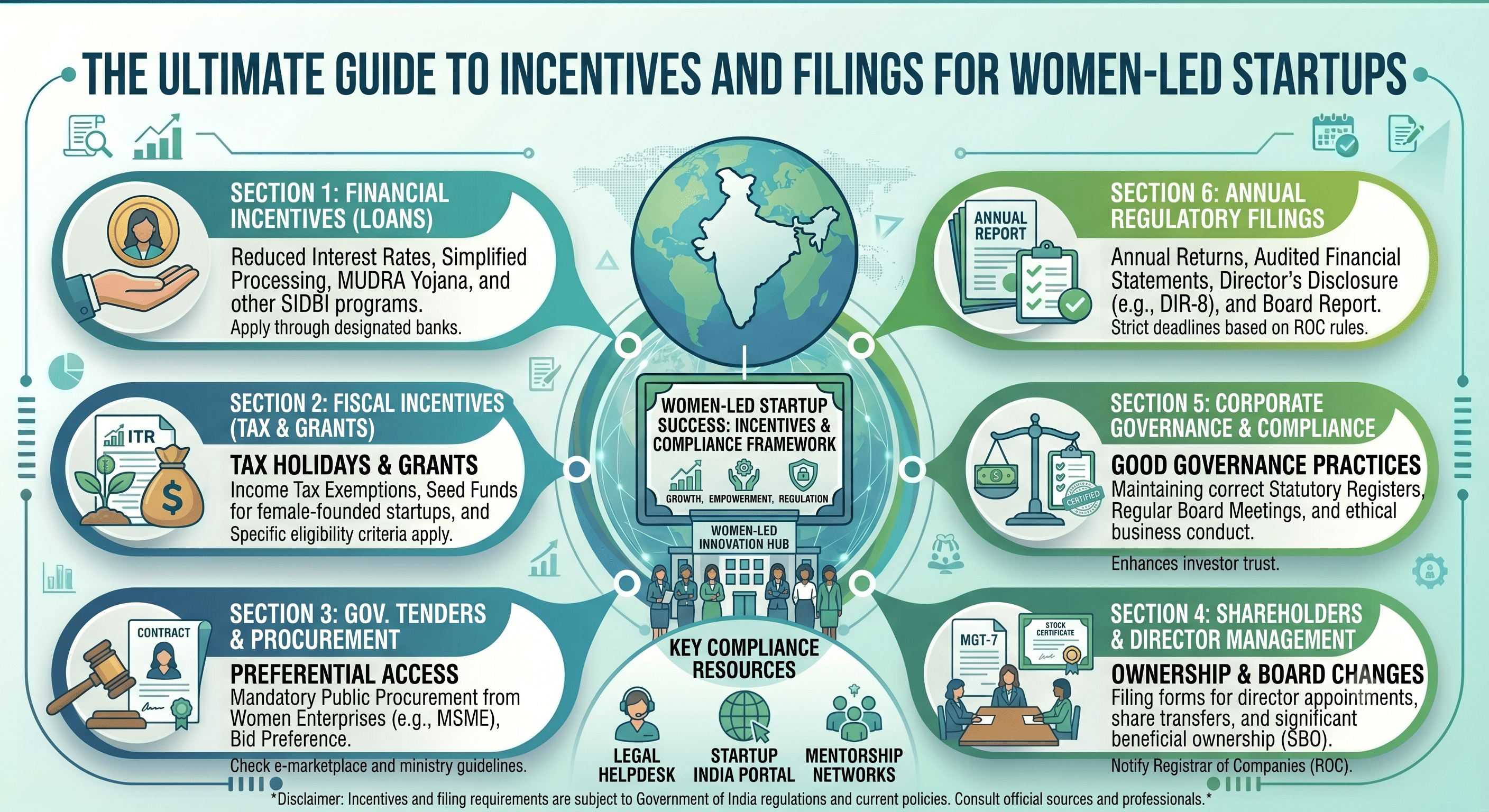
Powerful Government Schemes Every Female Founder Must Know
The Indian government has created multiple entry points for women to secure capital, mentorship, and market reach. Here are the most impactful initiatives available today.
1. The Stand-Up India Scheme
If you are planning to launch a new manufacturing, trading, or service-based business, this is one of the most reliable credit avenues available. Stand-Up India facilitates bank loans ranging from 10 lakh rupees up to 1 crore rupees for greenfield projects.
Under this scheme, at least one scheduled commercial bank branch must extend a loan to at least one woman entrepreneur. The program offers highly competitive interest rates and requires a relaxed margin money contribution, making it significantly easier to get your operations off the ground.
2. The Brand-New SHE-Mart Scheme
Introduced in the Union Budget, the SHE-Mart initiative (Self-Help Entrepreneur Marts) is a revolutionary step toward providing direct market access. This scheme establishes organized retail outlets and digital platforms that allow women entrepreneurs to sell and promote their products directly to corporate and retail consumers, eliminating expensive middlemen and helping you build a highly visible, sustainable brand.
3. Pradhan Mantri Mudra Yojana (PMMY)
For early-stage startups and small businesses requiring working capital, Mudra loans offer collateral-free institutional credit. The scheme is divided into three categories based on the stage of your business: Shishu (loans up to 50,000 rupees), Kishor (loans up to 5 lakh rupees), and Tarun (loans up to 10 lakh rupees). The government has also introduced a "Tarun Plus" category of up to 20 lakh rupees for repeat borrowers, giving women-led enterprises access to rapid growth capital without risking personal assets.
4. NITI Aayog's Women Entrepreneurship Platform (WEP)
The WEP is a highly collaborative aggregator platform designed to bring women entrepreneurs together with industry leaders, investors, and mentors. It offers structural support across six key pillars: funding assistance, incubation, compliance and tax help, entrepreneur skilling, marketing support, and community networking.
The Essential Filing Checklist: Turning Incentives into Reality
To successfully claim subsidies, secure low-interest loans, or participate in public procurement programs, your startup must maintain flawless corporate hygiene. The government will conduct deep regulatory checks before approving your applications.
These are the core steps and filings you must prioritize:
1. Choose the Right Legal Structure
While many women start their journeys as informal home businesses, transitioning to a formal structure is essential to unlock big-ticket incentives. Registering as a Private Limited Company or a Limited Liability Partnership (LLP) gives you the corporate status required to apply for DPIIT recognition, venture capital funding, and major bank loans.
2. Secure DPIIT Startup Recognition
The Department for Promotion of Industry and Internal Trade (DPIIT) offers a specialized recognition certificate that unlocks tax holidays, patent filing rebates, and relaxation of public procurement norms. During the application, highlight your unique business model, innovative tech, or sustainable solutions to ensure a smooth approval process.
3. Register on the Udyam Portal (MSME)
An MSME registration is a vital key that unlocks collateral-free loans, interest rate concessions, and the powerful 45-day delayed payment protection law. Ensure your business activities are classified under the correct National Industrial Classification (NIC) codes to maximize your eligibility for sector-specific benefits.
4. Maintain Flawless ROC and GST Compliances
Whether you are applying for a government tender on the Government e-Marketplace (GeM) or pitching to an impact investor, your public records must be spotless. Missing your annual ROC filings (such as Form AOC-4 or MGT-7) or delaying your monthly GST returns can instantly trigger red flags, halting your loan processing or disqualifying you from critical schemes.
Why Navigating This Journey with Business Consultants is Smart?
The path to building a successful startup is full of operational demands. Spending your valuable time analyzing complex government portals, draft agreements, and tracking filing deadlines can easily distract you from scaling your product and building your team.
This is where working with professional business advisors and corporate advisory experts in India becomes incredibly valuable.
How Globaton Empowers Your Startup Journey:
● Strategic Equity Structuring: We help you structure your shareholding patterns and founder agreements perfectly to ensure you meet the strict 51% equity requirement for government incentives.
● End-to-End Registration & Approvals: Our skilled company registration consultants manage your complete company registration, GST setup, MSME registration, and DPIIT recognition flawlessly.
● Seamless Ongoing Compliance: From keeping your directors' KYC active to managing your annual ROC filings and corporate tax planning, our team handles the legal details so you can focus entirely on your vision.
Scale with Confidence and Support
You have the vision, the passion, and the drive to build a market-defining business. By securing the right government incentives and maintaining a compliant legal foundation, you protect your equity and build a resilient, investor-ready brand that can scale rapidly.
At Globaton, we are proud to act as strategic partners for women entrepreneurs across India. We believe in simplifying complex regulatory frameworks so you can focus on changing the world.
Let us help you build a strong, compliant, and thriving startup. Reach out to Globaton today to explore how our business advisors can streamline your registration, filings, and incentive applications.
Frequently Asked Questions
What is the exact legal definition of a "women-led" startup in India?
To qualify for most state-backed subsidies, public procurement benefits, and low-interest bank loan programs, your startup must meet a strict legal standard: -Equity Ownership: One or more female entrepreneurs must hold at least 51% of the total share capital or partner equity in the business. -Management Control: The day-to-day administrative, operational, and financial decision-making power of the startup must rest in the hands of women. While certain international programs or venture capital circles relax this threshold to 33% for co-founded teams, Indian government-backed schemes enforce the 51% rule very strictly. Our company registration consultants can help you structure your shareholder agreements to preserve this crucial threshold while keeping you ready for venture capital.
How does the brand-new SHE-Mart initiative help women-led businesses scale?
Announced as a major highlight, the SHE-Mart (Self-Help Entrepreneur Marts) scheme is a game-changer designed to transition women from micro-earners to formal enterprise owners. This program establishes organized, community-owned retail outlets and aggregation hubs. The biggest benefit is the elimination of expensive middlemen. SHE-Marts are backed by: -Zero-Commission Digital Selling: Complete integration with the Open Network for Digital Commerce (ONDC) to help you sell across India without high platform fees. -Affordable Shipping: A strategic partnership with India Post to manage last-mile logistics and deliveries at subsidized rates. -Professional Branding: Direct assistance with packaging, standardization, and regional brand development to help your products command premium prices.
Can we secure collateral-free loans for our service-based startup?
Yes. Many founders assume that major funding schemes only support manufacturing or physical goods, but service-based businesses (like software firms, digital agencies, and consultancy setups) are fully eligible. You can access collateral-free institutional credit through: -The Stand-Up India Scheme: Provides bank loans ranging from 10 lakh rupees up to 1 crore rupees for greenfield (newly launched) service projects. The interest rates are highly competitive, and the margin money requirements are relaxed. -Pradhan Mantri Mudra Yojana (PMMY): Offers collateral-free micro-loans. Under the updated guidelines, the maximum limit has been increased to 20 lakh rupees for repeat borrowers under the new "Tarun Plus" category, giving you rapid access to expansion capital without risking personal assets.
What is the "Womaniya" initiative, and how does it help with government contracts?
The "Womaniya" initiative is a specialized section on the Government e-Marketplace (GeM), which is India's massive public procurement portal. By law, government departments and public sector undertakings must procure a certain percentage of their annual goods and services from women-owned micro and small enterprises (MSEs). Registering under the Womaniya banner allows you to pitch directly for lucrative government tenders without paying heavy security deposits (Earnest Money Deposits). This helps you secure long-term contracts and build an incredibly stable financial runway.
What is the TREAD scheme, and how can we use it to launch our business?
The Trade Related Entrepreneurship Development Assistance (TREAD) scheme is a highly supportive program designed to bridge the structural funding gap for female entrepreneurs. Under TREAD, the government provides a grant of up to 30% of the total estimated project cost to non-governmental organizations (NGOs) or development institutions. These institutions then package the grant with bank credit to offer you comprehensive, low-interest funding, alongside structured entrepreneurship training, counseling, and market-linkage support.
What core compliance filings must we maintain to keep our incentives active?
Securing a government scheme is only half the battle: you must maintain spotless corporate governance to avoid losing those benefits. The state will audit your company before releasing subsidies or approving loan disbursements. You must prioritize: -Active Udyam (MSME) Registration: Ensure your business is registered on the Udyam portal and classified under the correct National Industrial Classification (NIC) codes. -Annual ROC Submissions: Submit Form AOC-4 (for financial statements) within 30 days of your AGM and Form MGT-7 or MGT-7A (for annual returns) within 60 days of your AGM. -Director Verification: Every female director must complete her DIR-3 KYC verification by September 30th every single year to keep her director status active.